



ANU for Indian Students: The Complete Honest Guide for 2026-2027
The Australian National University (ANU) is one of Australia's most respected universities - ranked 32nd globally and a serious option for Indian students with strong academic profiles planning to Study in Australia in 2026 or 2027. What most articles won't tell you: Canberra's regional status gives ANU graduates 3-4 years of post-study work rights, not the standard 2. Scholarships are real, but the 25% one is genuinely competitive - the 20% one is far more accessible than universities let on. This guide covers the exact eligibility numbers, the documentation trap that stalls applications after offer letters are issued, and which student profiles ANU will and won't work for.
ANU for Indian students: The complete honest guide for 2026–2027
Every year, Indian students and their parents spend weeks researching Australian universities comparing rankings, reading brochures, watching YouTube videos and still arrive at the same unresolved question
"But is ANU actually right for me?"
Rankings don't answer that. Brochures definitely don't. So this guide will.
The Australian National University was established in 1946 as Australia's National University. Group of Eight. 32nd in the world, QS rankings. Those numbers get quoted a lot. What gets quoted less: 96% of ANU's research meets or exceeds world standards, 87% of its academic staff hold PhDs, and it holds a seat in the International Alliance of Research Universities [IARU] alongside just 10 other universities globally. No other Australian university is in that group.
For students planning to Study in Australia with serious academic ambitions, that context matters more than a rank.
The Canberra advantage: lower costs, longer work visa, and why most students overlook it

The Canberra advantage most students dismiss too quickly
Here's the conversation that happens in almost every counselling session about ANU.
Student: "But it's in Canberra. Not Sydney. Not Melbourne."
Fair concern. But students who dismiss Canberra on that basis alone are missing something concrete.
Canberra is quieter. The campus is self-contained. The social scene is different from a metro city. All true. But the academic environment is focused in a way that large city campuses rarely are. Less distraction. Better staff-to-student ratios - ANU has a five-star rating on this. Canberra is the capital. That sounds obvious until you think about what it actually means - government departments, embassies, research bodies, policy think tanks, all concentrated in one mid-sized city. If your ambitions sit anywhere near public policy, international affairs, or applied research, you're not just studying near these institutions. You're potentially knocking on their doors for internships and projects while still enrolled.
Post-Study Work Visa: Why Canberra gives you more time than Sydney or Melbourne
This is the part most articles bury. It deserves to be said clearly.
ANU graduates in Canberra qualify for a regional post-study work visa. That means 3 to 4 years of work rights in Australia after graduation — not the standard 2 years that Sydney or Melbourne graduates receive. The exact duration depends on your program and subject selection, but the baseline advantage is a full extra year.
For Indian students thinking about long-term career prospects in Australia, that additional year is not a minor footnote. It's a meaningful difference in how much time you have to find employer sponsorship, build experience, or explore your options.
Who actually gets into ANU - The real eligibility picture
CBSE and ICSE requirements decoded
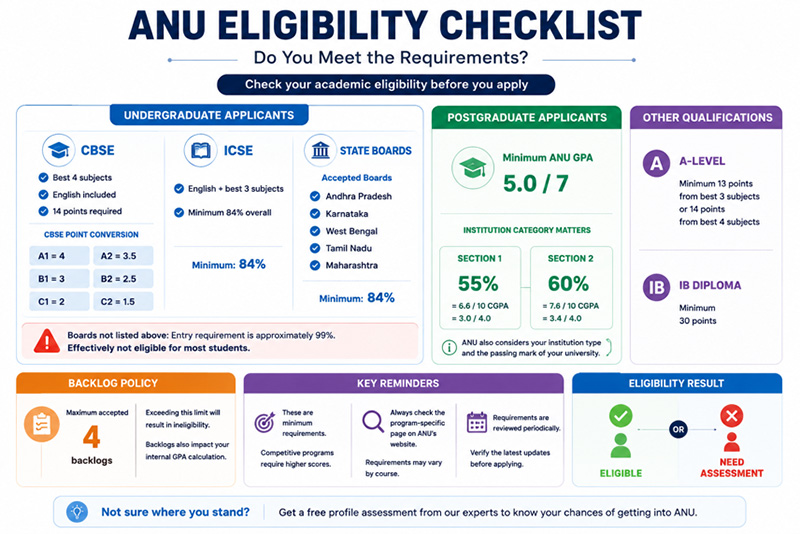
ANU uses a points-based assessment for CBSE students. ANU needs 14 points from your best four subjects - English included. The point conversion from CBSE grades goes like this: A1 gives you 4, A2 gives 3.5, B1 gives 3. Add those up across your four subjects. If it hits 14, you're at the minimum threshold.
For ICSE students, the requirement is English plus your best three subjects, with an overall minimum of 84%.
These are minimums. Competitive programs - particularly in Computing, Law, and Sciences - will require higher scores. Always check the subject-specific page on ANU's website for the program you're targeting.
Which State Boards ANU accepts and the ones that won't work
This is where a lot of applications go wrong before they even start.
ANU currently accepts five Indian state boards beyond CBSE and ICSE: Andhra Pradesh, Karnataka, West Bengal, Tamil Nadu, and Maharashtra. The minimum requirement for these boards is 84%.
If you're from Haryana, Punjab, Gujarat, Rajasthan, or any other state board not on that list — the answer is almost certainly no. Technically, ANU's website lists an option for other state boards, but the entry requirement sits at 99%, which is effectively a closed door. Don't build your plans around an exception that almost never applies.
For A-Level students, ANU needs a minimum of 13 points from best three subjects or 14 points from best four. IB students need a minimum of 30 points.
How ANU calculates your GPA? Why backlogs hurt more than you think?
ANU has a maximum of four backlogs - beyond that, the application will not proceed.
But here's the part most students underestimate. ANU recalculates your GPA internally, and backlogs pull that average down even if your overall percentage looks acceptable. If you have 72% and two backlogs, your actual ANU GPA may calculate lower than your percentage suggests. Admissions also looks at your institution type and the passing mark of your university when making this assessment.
The practical reality: if you have backlogs, get your GPA calculated properly before submitting anything. An application submitted on a borderline profile wastes months and creates a refusal record that follows you.
The Scholarship Reality Check
The 20% International Merit Award - Who gets it and how quickly
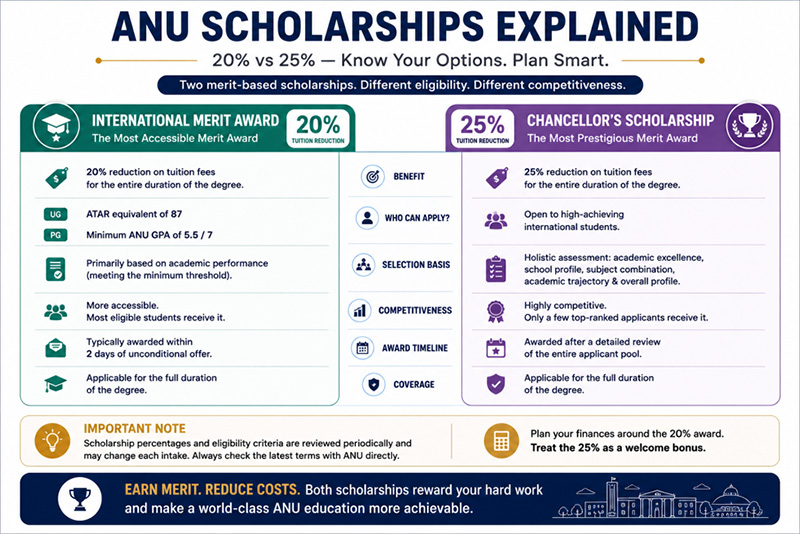
Twenty percent off. For the entire degree. Not just year one.
ANU's tuition for international students currently runs between AUD 44,000 and AUD 56,500 a year. Run that 20% against those numbers and you're looking at AUD 8,800 to AUD 11,300 back in your pocket - every single year. Across a 2-3 year program, that's significant.
Who qualifies? Undergraduate students need an ATAR equivalent of 87. Postgraduate students need a minimum ANU GPA of 5.5 out of 7. Hit those numbers and the award typically lands in your inbox within two days of your unconditional offer. Most eligible students get it. It's not a lottery.
One thing worth knowing: this scholarship is designed for conversion, not exclusivity. Most eligible students get it. If you receive an unconditional offer and the merit award hasn't arrived within two days, flag it with your counsellor — it can be followed up directly with ANU.
One thing worth saying plainly, scholarship percentages and eligibility criteria do get revised. What applies for the July 2026 intake may not be identical for 2027. Before you build a budget around these numbers, check the current terms with ANU directly or ask your counsellor to confirm.
The 25% Chancellor's Scholarship - Why high grades alone don't guarantee it
The Chancellor's International Scholarship offers a 25% tuition reduction for the full duration of study. It's competitive. Genuinely competitive - not the kind of competitive that means "apply and see what happens."
The scholarship team looks beyond GPA scores. Which school you attended, your subject combination, your academic trajectory - these are all factors in the assessment. The entire cohort of international applicants competes for this scholarship, and the highest-ranked profiles get it. Four students with 90% do not all receive it. One might.
If your profile is strong, apply for it - but build your entire financial plan around the 20% award, not the 25%. The Chancellor's Scholarship is a welcome surprise, not a planning assumption.
The new September Intake - What Indian students should know
ANU has launched a September intake as a pilot for 2026. Currently, it covers one program: Bachelor of Commerce, with Business Information Systems as the major. Students choose one minor from several available options.
Applications close 20th July 2026. You have until 3rd August to accept. Classes begin 14th September. The window is tighter than the July intake.
July or September? Honestly, it comes down to two things - when your documents will be ready, and whether a Bachelor of Commerce with a Business Information systems major is actually what you want to study. If both answers point to September, it's worth exploring. If either answer is uncertain, July is the safer choice. Getting proper course selection advice before committing to either intake is worth the time.
The GS Form & Financial Documentation - where applications get stuck
Why some students get an offer letter but can't pay fees yet
This is one of the most confusing parts of the ANU application process right now and it catches students off guard at exactly the wrong moment.
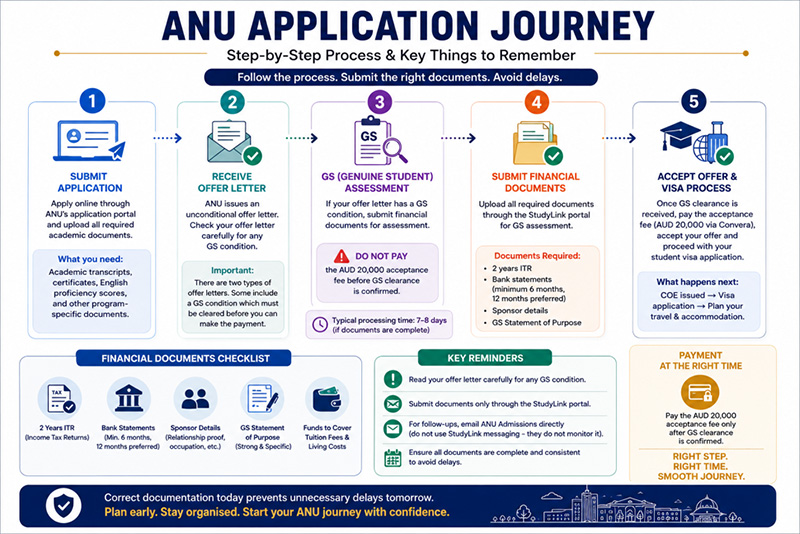
ANU issues two types of unconditional offer letters. The first looks like a standard full offer, but contains a GS (Genuine Student) condition meaning your financial documents must be verified before you can make the acceptance payment. The second is a clean unconditional offer with no GS condition, and payment can proceed immediately.
Both look like offer letters. The difference is in the detail. Read your offer letter carefully for any mention of GS requirements. If there is one, do not make the acceptance payment until GS clearance is confirmed. ANU's acceptance requires a payment of AUD 20,000 at the time of acceptance through Convera and paying before GS clearance is resolved creates complications that are difficult to undo.
GS assessment typically takes 7 to 8 days when documentation is complete. Incomplete documents extend that timeline significantly.
If you're unsure what your offer letter means or whether you're ready to proceed, speak with a Global Reach counsellor before making any payment. Our visa and application team has handled this process across multiple intakes and can tell you exactly where you stand.
What financial documents ANU actually wants to see?
ANU wants to see that tuition fees and living costs are genuinely and clearly covered. The current benchmark for annual income is approximately AUD 17,000, though this figure is reviewed periodically. Two years of ITRs are required. Bank statements should cover a minimum of six months. Twelve months is advisable where the six-month picture shows inconsistency.
Your GS Statement of Purpose matters more than most students realise. It needs to clearly identify your sponsor, explain the funding source, and connect your academic background to your chosen ANU program. Vague or circular explanations slow down assessment. Clean, specific, logically connected SOPs clear in days.
All documents are submitted through the StudyLink portal. If you need to follow up or send updates, email ANU admissions directly do not use StudyLink's own messaging system, as ANU admissions does not monitor it and your message will go unanswered.
Postgraduate requirements - The numbers Indian Students need to know
Most ANU postgraduate programs require a minimum ANU GPA of 5 out of 7. Here is what that means in Indian grading terms.
Where your institution sits in ANU's internal classification changes the numbers significantly. Section 1 institutions: you need at least 55% - that's 6.6 out of 10 CGPA, or 3.0 on a 4-point scale. Section 2 institutions set the bar higher: 60%, which translates to 7.6 out of 10 CGPA, or 3.4 out of 4. Not sure which category your college falls into? That's worth finding out before you assume you're eligible.
These are minimums. Admissions also considers the passing mark of your institution a 55% from a university where the passing mark is 40% reads differently from a 55% where the passing mark is 50%. If your numbers are sitting close to the borderline, get a proper profile assessment before submitting. Borderline applications that come back refused create records and records matter for future applications.
For students who completed a BCA (three-year degree), this is generally acceptable for postgraduate computing programs. Students applying for a second master's degree need to demonstrate a logical academic or professional transition not just a subject connection, but a genuine reason the second degree follows naturally from where you currently are.
ANU vs Other Australian Universities - An Honest Comparison for High Achievers
The question most Indian students are actually asking is: "Why ANU over Melbourne, Sydney, or UNSW?"
Honest answer: it depends entirely on your field.
For research, public policy, international relations, and political science, ANU has few equals in Australia. Its position in Canberra, its IARU membership, and its research infrastructure make it genuinely differentiated for these disciplines. The post-study work visa advantage is a real, quantifiable benefit that Sydney and Melbourne cannot match.
For business, engineering, and computing in a large city with a wider job market during study, a larger Indian student community, and broader industry networks -Sydney, Melbourne, and UNSW offer advantages ANU doesn't. And those are real factors, no reasons to dismiss ANU, but reasons to be honest about what you're actually looking for. There's no objectively better university in this comparison. There's only the one that fits your subject, your career direction, and the kind of experience you want from your years in Study in Australia. That's a different question for every student.
Common profile situations - Is ANU realistic for you?
Recent refusals particularly from the last six months are a real risk at ANU. The university has tightened its application assessment across South Asia, and a recent refusal from a comparable university applying for a similar course will be scrutinised closely.
A refusal from a top-ranked university where your profile is genuinely strong, finances are clean, and the course choice is consistent that can be worked with. A pattern of refusals is a different situation entirely. Be completely transparent about your refusal history when you speak with a counsellor. The application strategy depends on it, and there's no advantage in withholding it. Talk to a Global Reach counsellor to understand exactly how your situation will be assessed before submitting.
How Global Reach can help with your ANU application
Knowing the eligibility criteria is one thing. Getting your application through cleanly, correctly, without delays or surprises is another.
Global Reach has been guiding Indian students through overseas university applications for over 35 years. For ANU specifically, that means understanding where your profile actually stands before you apply. Not after. It means knowing which scholarship to target realistically, preparing GS documentation that moves through assessment without stalling, and reading your offer letter correctly so you don't make a payment at the wrong time.
If you're considering Study in Australia and want to know whether ANU is the right fit for your academic background and career goals, start with a proper profile conversation. Not a general enquiry. A real assessment of where you stand and what your next step should be.
Conclusion
ANU is not the right university for every Indian student and it doesn't try to be. It's built for students who want research depth, academic rigour, and a degree from one of Australia's most respected institutions. The Canberra location, which so many students initially resist, turns out to be one of ANU's most concrete advantages: a focused academic environment, lower living costs than Sydney or Melbourne, and a post-study work visa that gives you more time to build your future in Australia than any metro university can offer.
What this guide has tried to do is give you the actual picture — the GPA calculations that determine real eligibility, the scholarship most qualifying students will receive versus the one that's genuinely competitive, the documentation process that stalls good applications that nobody warned you about in advance.
If your profile fits, ANU deserves serious consideration. If it doesn't, knowing that now saves months of misdirected effort and a refusal record you don't need.
The next step isn't another article. It's a conversation about your specific profile, your target program, your timeline, and your documentation. That's where real decisions get made and that's exactly what Global Reach counsellors are here for.
FAQs
Q1: Does ANU accept students from all Indian state boards?
No - and this surprises many students. ANU currently accepts five Indian state boards beyond CBSE and ICSE: Andhra Pradesh, Karnataka, West Bengal, Tamil Nadu, and Maharashtra. If your board isn't on that list, the threshold listed on ANU's website for other boards is approximately 99% — effectively a closed door for most. Before investing time in an ANU application, confirm your board eligibility first. A quick conversation with a counsellor can save you weeks of effort in the wrong direction.
Q2: How does ANU calculate GPA for Indian postgraduate applicants and do backlogs affect it?
Yes, backlogs directly affect ANU's internal GPA calculation not just your eligibility on paper. ANU recalculates your GPA using its own conversion system, and backlogs pull that average down even if your overall percentage appears acceptable. The calculation also accounts for your institution's passing mark and category. The maximum number of backlogs accepted is four; beyond that, the application will not proceed regardless of percentage.
Q3: What is the real difference between the Chancellor's Scholarship and the International Merit Award at ANU?
The Chancellor's Scholarship offers 25% off tuition for the full degree duration and is genuinely competitive - the entire international cohort competes for it, and grades alone don't determine the outcome. The International Merit Award offers 20% off and is accessible to most students who meet the threshold: ATAR equivalent 87 for undergraduate, ANU GPA 5.5 for postgraduate. Most eligible students receive the 20% award within two days of their offer. Plan your finances around the 20% treat the 25% as a bonus if it comes. Scholarship values may change each intake; always confirm current terms before finalising your financial plan.
Q4: Is Canberra a good city for Indian students?
It depends on what you're looking for. Canberra has a smaller Indian community than Sydney or Melbourne, fewer walk-in part-time job opportunities, and a quieter social environment. What it does offer is a focused academic setting, lower living costs, and direct access to Australia's government and policy ecosystem which matters enormously for certain career paths. The 3-4 year regional post-study work visa is a concrete advantage that no metro city university can match. Students who want a large-city experience during their degree may find Canberra limiting. Students who want academic depth and a longer runway in Australia after graduation tend to find it works very well.
Q5: What is the post-study work visa duration for ANU graduates in Canberra?
ANU graduates in Canberra qualify for a regional post-study work visa of 3 to 4 years - compared to the standard 2 years for graduates from Sydney or Melbourne. The exact duration depends on your program and subject selection. That additional year makes a meaningful difference for students exploring employer sponsorship pathways or building Australian work experience after graduation.
Q6: Can a student with a previous Australian or UK visa refusal apply to ANU?
It depends on when the refusal happened and why. A refusal from six or more months ago, where you were applying to a comparable university for a similar course, can be considered if the profile is strong and financials are clean. Recent refusals - particularly in the last six months - carry significant risk at ANU, which has tightened its application assessment across South Asia. A pattern of refusals from multiple countries is treated as a serious red flag. Every case is different and needs individual assessment. Speak with a Global Reach counsellor before submitting — a rushed application with a refusal history does more damage than waiting.
Q7: What is the GS form at ANU and why do some students get stuck after receiving an offer?
The GS (Genuine Student) form is ANU's verification process for a student's genuine academic intent and financial capacity. Some offer letters arrive with a GS condition attached meaning you cannot make the acceptance payment until GS clearance is complete. This catches many students off guard because the letter looks like a standard unconditional offer. Always read your offer letter carefully for any mention of GS requirements before making the AUD 20,000 acceptance payment. GS assessment takes 7–8 days when all documents are in order. Incomplete or inconsistent documentation extends that significantly.
Q8: What is the new September intake at ANU and who is it for?
ANU has launched a pilot September intake for 2026, currently offering one program: Bachelor of Commerce with Business Information Systems as the major. The application deadline is 20th July 2026 and the course starts 14th September 2026. The first semester is more intensive than the standard July intake because September students sit the same November exams as July starters. From semester two onwards, the pace normalises. This is a small pilot cohort — worth considering if you missed the July deadline and the commerce program fits your goals.
Q9: How many backlogs does ANU accept?
The maximum is four backlogs. Beyond four, ANU will not consider the application. Within that limit, the number and pattern of backlogs still affects the internal GPA calculation - so meeting the maximum threshold does not automatically mean the GPA will be sufficient for your target program. A careful profile assessment before applying is always worth the time.
Q10: Is ANU harder to get into than other Group of Eight universities in Australia?
Not categorically - it depends on the program. ANU's entry requirements are comparable to other Go8 universities for most disciplines. Where ANU stands apart is the state board restriction: only five Indian state boards are accepted beyond CBSE and ICSE, which eliminates a significant number of applicants before academic assessment even begins. For CBSE and ICSE students with clean profiles, ANU's competitiveness is broadly similar to other Go8 institutions. The GS documentation process has become more rigorous across all Go8 universities - ANU is no exception.
Useful Resources
Official ANU Website: https://www.anu.edu.au/
For program-specific entry requirements, current scholarship details, and application deadlines, always refer directly to ANU's official website. Information in this article reflects details current at the time of writing and may be subject to change.