


Foreign University Campuses in India: A New Era for Global Education - But is it the Right Choice for You?
Not too long ago, the option to getting an international degree was straightforward; you packed your bags, applied for a student visa and headed overseas.
Today, that journey is evolving.
Walk through education exhibitions or scroll through university announcements, and you'll notice a growing trend: internationally renowned universities are opening campuses in India.
From Mumbai and Bengaluru to Gurugram and GIFT City, students now have the opportunity to study at institutions such as University of York, University of Western Australia (UWA), Illinois Institute of Technology, University of Liverpool, University of Southampton, Deakin University, Queen's University Belfast, University of Bristol, and University of Aberdeen without leaving the country.
It's a significant shift in India's higher education landscape and one that is creating plenty of excitement.
For students and parents alike, however, one question remains:
If you can earn an international degree in India, does it still make sense to study abroad?
The answer depends on what you're looking for. While foreign university campuses make global education more accessible, they don't necessarily replace the overseas experience.
Understanding the difference is the key to making the right decision.
Why Are Foreign University Campuses Opening in India?
India has long been one of the world's largest contributors to international student mobility. At the same time, it is home to one of the largest higher education ecosystems, with over 43 million students enrolled across colleges and universities, according to the All India Survey on Higher Education (AISHE 2021–22).
Recognising both the demand for international education and India's growing global influence, the National Education Policy (NEP) 2020 proposed allowing leading foreign universities to establish campuses in India. This vision took shape when the University Grants Commission (UGC) introduced regulations in 2023 permitting eligible institutions to operate in the country.
Importantly, not every overseas university can open a campus. Under the regulations, only universities ranked among the world's top 500 globally or in specific subject areas, or those recognised for exceptional academic excellence, are eligible. This quality benchmark is intended to ensure that students receive education aligned with international standards.
For Indian students, this means global education is no longer an aspiration reserved only for those who can relocate overseas, it is increasingly becoming available closer to home.

What is a Foreign University Branch Campus in India?
A branch campus isn't a franchise or a study centre.
It is an extension of the parent university, expected to follow its academic framework, curriculum and quality standards.
Students study programmes developed by the overseas institution, are assessed under its academic policies and, in many cases, receive the same degree awarded by the parent university. Several universities have also indicated that the qualification does not specify the campus location, though students should always confirm this directly with their chosen institution.
This distinction matters because it sets branch campuses apart from many collaborative or twinning programmes that have existed in the past.
Foreign Universities with Campuses in India
India's international education ecosystem is expanding rapidly. Universities that have announced or established campuses include:
| University | Indian Campus | Location | Programs |
|---|---|---|---|
| Illinois Institute of Technology | Mumbai | Mumbai | Engineering, AI, Business |
| University of Southampton | Gurugram | Haryana | Computer Science, Business |
| University of Liverpool | Bengaluru | Karnataka | Business, Finance, Computing |
| Queen's University Belfast | GIFT City | Gujarat | Business, Computing |
| Deakin University | GIFT City | Gujarat | Business, Cybersecurity |
| University of Western Australia (UWA) | Mumbai | Maharashtra | Business, STEM |
| University of Bristol | Mumbai | Maharashtra | AI, Data Science, Economics |
| University of Aberdeen | Mumbai | Maharashtra | Energy, Business, Finance |
| University of York | Mumbai | Maharashtra | Computer Science, Business, AI |
Why Students are Choosing Global Education in India
A global degree without the global price tag
For many Indian families, cost is the single biggest barrier to studying abroad.
Beyond tuition, students must account for accommodation, travel, visa expenses, insurance and currency fluctuations. Collectively, these costs can make overseas education a substantial financial commitment.
Foreign university campuses address part of this challenge by allowing students to earn an international qualification while significantly reducing living and relocation costs. Discussions with university representatives indicate that tuition fee at several campuses approximately ?13–23 lakh per year, depending on the university, programme, and level of study.
While many undergraduate programmes fall in the ?13–17 lakh range, several postgraduate programmes may cost up to ?23 lakh annually with scholarships and fee waivers available at selected institutions.
For students seeking an internationally recognised degree without the additional cost of relocating abroad, this is an attractive proposition.
Industry-Focused Learning at International Campuses in India
One of the most interesting developments isn't the curriculum, it's how these universities are preparing students for employment.
During interactions with Global Reach, university representatives consistently emphasised that they had begun building relationships with employers and industry bodies even before admitting their first students. Their objective is to integrate internships, live projects, guest lectures and professional certifications into the learning experience from the outset.
Rather than relying solely on classroom instruction, many campuses are positioning themselves as skill-focused institutions designed around employability.
That aligns well with today's job market, where employers increasingly value practical experience alongside academic qualifications.
Popular Courses Offered at Foreign University Campuses in India
Most international campuses have chosen to launch programmes in disciplines where demand continues to grow globally.
These include:
- Artificial Intelligence
- Computer Science
- Data Science
- Cybersecurity
- Engineering
- Business Analytics
- Business and Management
- Economics
- Accounting
- Finance
Interestingly, campus locations have also been selected strategically. Several universities are situated in business hubs such as GIFT City, Bengaluru and Mumbai, allowing closer collaboration with industries that students are likely to work with after graduation.
Who Benefits Most from Global Education in India?
Every year, Global Reach meets students whose overseas plans change because of finances, visa challenges or personal circumstances.
For these students, an international branch campus can offer another pathway - not as a substitute for studying abroad, but as an alternative that keeps them connected to a globally recognised institution. University representatives also highlighted this as a key audience, alongside students considering premium private universities in India.
Who Should Apply for a Foreign University Campus in India?
A foreign university campus in India could be the right choice if you:
- Want an internationally recognised degree without moving overseas.
- Prefer a more affordable pathway by saving on living and relocation costs.
- Want industry-focused learning with internships and practical exposure.
- Need to stay closer to home due to personal or financial reasons.
- Plan to build your career in India while studying at a globally reputed university.
- Are comparing premium private universities in India with international institutions.
If your priority is global education in India with lower overall costs, a foreign university campus is worth considering. If you're looking for international exposure, cultural immersion and overseas work opportunities, studying abroad may still be the better choice.
Global Reach Insight
A senior counsellor of Global Reach stated,
“One of the biggest misconceptions we come across is that a foreign university campus in India is either a replacement for studying abroad or a shortcut to it. In reality, they're two different pathways designed for different goals. For some students, staying in India while earning an international degree makes perfect sense. For others, the value lies in the overseas experience, global networking and post-study work opportunities. The right choice isn't about following a trend - it's about choosing the pathway that best supports your academic and career ambitions.”
Did You Know?
A common misconception is that these campuses exist mainly to help students transfer abroad later.
That's not the case.
Most universities expect students to complete their entire programme in India. While semester exchanges and campus transfers are available at some institutions, they remain optional opportunities subject to academic performance, university policies, visa approvals and financial eligibility.
What Studying Abroad Still Offers That Indian Campuses Can't
Foreign university campuses bring international education to India but they cannot recreate every aspect of studying overseas.
Living in another country means adapting to a new culture, managing life independently, building friendships with students from across the world and gaining exposure to different workplaces and communities.
Depending on the destination, studying abroad may also provide opportunities for part-time work, post-study work rights and international career pathways.
These experiences remain unique to overseas education.
For students whose long-term goal is global mobility, international employment or migration, studying abroad continues to offer advantages that an Indian campus cannot fully replicate.
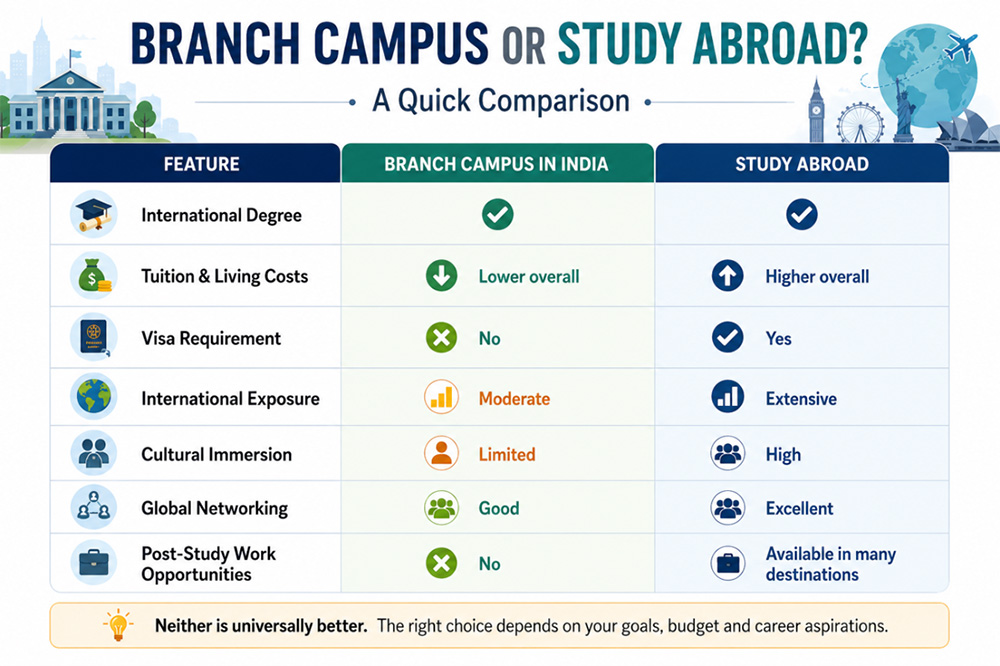
Global Reach Helps You Choose Between Studying Abroad and Global Education in India
At Global Reach, our counselling conversations have changed.
A few years ago, students would ask, "Which country should I choose?"
Today, another question often comes first
"Should I study abroad at all, or should I consider one of these new campuses in India?"
Some students will benefit more from the affordability and convenience of an Indian branch campus. Others may be better served by the complete overseas experience, particularly if international work opportunities or long-term migration are part of their plans.
With 35 years of experience in international education, Global Reach helps students evaluate both pathways objectively. From comparing universities and programme outcomes to understanding scholarships, career prospects and campus transfer opportunities, our focus is on helping students choose the option that best aligns with their ambitions, not simply the newest trend.
With the arrival of foreign university campuses marks a new chapter in India's higher education journey.
For the first time, students have access to globally recognised universities without leaving home country. That's a remarkable development, especially for those looking for quality education overall at a lower cost.
An international degree and an international experience are not always the same thing.
If your dream is to be a part of a new culture, build a global network and explores career opportunities overseas, studying abroad still offers experiences that you cannot get within India.
The good news is that today's students don't have to choose between a "good" option and a "better" one. They have more choices than ever before.
The smartest decision is the one that fits
Your goals, your budget and your future.
FAQs
1. Are foreign university campuses in India recognised by the UGC?
Yes. Eligible institutions must receive approval under the UGC Regulations for Foreign Higher Educational Institutions before operating in India.
2. Will I receive the same degree as students at the overseas campus?
Many universities state that graduates receive the same parent university degree, though students should verify this directly with the institution.
3. Is it cheaper than studying abroad?
Generally, yes. Students save on accommodation, travel, visa costs and other relocation expenses while often paying lower tuition than at the overseas campus.
4. Can I transfer to the parent campus later?
Some universities offer exchange programmes or campus transfers, but these are optional and subject to academic, visa and financial requirements.
5. Should I choose a branch campus or study abroad?
If affordability and staying closer to home are your priorities, a branch campus may be an excellent fit. If your goal is global exposure, international work opportunities and cultural immersion, studying abroad remains the stronger option.
Content Authored by:

With over a decade of experience in overseas education content writing, Rituparna Gupta brings deep insight, creativity, and authenticity to every piece she creates. She believes that the right words can inspire change and open minds.
Beyond her professional pursuits, she enjoys cooking, practising numerology, and spending quality time with her loved ones.