



Ireland vs UK for Indian Students: Which should you choose?
Study in Ireland and the Study in UK are both popular choices for Indian students, but they offer different advantages.
The UK stands out for its wide choice of universities, courses and student cities, while Ireland is particularly attractive for students interested in technology, pharmaceuticals, life sciences, finance and business.
For eligible master's graduates, Ireland's current Third Level Graduate Programme can provide up to 24 months of post-study permission. The UK's Graduate visa currently provides 18 months for most eligible bachelor's and master's graduates.
The right choice ultimately comes down to your course, budget, career plans and preferred lifestyle.
Ireland vs UK: At a Glance
| Factor | Ireland | UK |
|---|---|---|
| Popular fields | Technology, pharmaceuticals, life sciences, finance, business | Business, finance, engineering, technology, healthcare, law, creative fields, medical |
| Work during term | Up to 20 hours/week for eligible students | Generally up to 20 hours/week for eligible degree-level students |
| Work during specified holidays | 20 hrs during term time and 40 hrs in vacations | 20 hrs during term time and 40 hrs in vacations |
| Post-study option | Third Level Graduate Programme | Graduate visa |
| Eligible master's graduates | Up to 24 months | 18 months |
| University and course choice | Limited | Much wider |
| Major attraction | Strong multinational and technology ecosystem | Scale, variety and global university network |
Visa conditions depend on individual circumstances and course type.
Cost of studying & living
Cost is often the first concern for Indian students comparing Studying in Ireland and the Studying in UK. But there isn't a straightforward answer to which country is cheaper.
Your actual expenses depend on your University, Course, city and Accommodation.
London, for example, can be significantly more expensive than many other UK cities. Dublin can also be expensive, particularly when it comes to finding accommodation.
The UK currently requires students to demonstrate funds for living costs as part of the Student visa process. The amount varies depending on whether the student is studying in London or elsewhere in the UK.
Ireland's current financial requirement for a student on a one-year course is €10,000, in addition to the required evidence relating to course fees.
One thing students should avoid is planning to pay for their education entirely through part-time work. Employment can help with everyday expenses, but your primary education and living costs should already be covered.
Working while Studying
Ireland and UK both destinations allow eligible international students to work while studying, although the exact conditions differ.
Study in Ireland
Students with eligible Stamp 2 permission can generally work:
- Up to 20 hours per week during term time
- Up to 40 hours per week during specified holiday periods
The permitted 40-hour periods include June through September and 15 December to 15 January.
Study in UK
Eligible students Studying in UK qualifying degree-level courses can generally work up to 20 hours per week during term time, with full-time work generally permitted during official vacation periods. Some types of employment are restricted under Student Visa conditions.
Post-study work: Ireland vs UK
This is one of the biggest factors to consider if your plan is to work abroad after graduation.
Ireland
Ireland's Third Level Graduate Programme allows eligible international graduates to stay after completing their studies while they look for suitable employment and move towards an employment-permit route.
Under the current rules:
- Eligible Level 8 graduates can receive up to 12 months
- Eligible Level 9 or above graduates can receive up to 24 months
A Level 9 qualification generally includes master's-level study.
For Indian students planning a Master's in Ireland, this makes Ireland an option worth considering if staying on to gain international work experience is important to you.
UK
The UK's Graduate Visa allows eligible students to stay and work after completing an eligible course.
Under the current rules, most eligible Bachelor's and Master's graduates receive 18 months, while doctoral graduates can receive three years.
The Graduate visa is not extendable, but graduates may be able to move to another immigration route, such as the Skilled Worker route, if they meet the requirements.
Which has the advantage?
For an eligible master's graduate, Ireland currently offers a longer post-study period.
But that doesn't automatically make Ireland the better choice.
What matters is whether there are good opportunities in your field and whether you can eventually qualify for a longer-term work route.
Career Opportunities
The best country for your career depends heavily on what you want to study.
Best Courses in Ireland
For students interested in fields like Technology, Software and computing, Data and analytics, Pharmaceuticals, Biotechnology, Life sciences, Financial services and Business, Ireland's concentration of multinational companies can be a major attraction.
Popular Courses in UK
The UK's larger economy offers opportunities across a much broader range of industries, including Finance and banking, Biotechnology, Business and management, Engineering, Technology, Healthcare, Law, Media, Creative industries, Research and academia
London is one of the world's major financial centres, while cities such as Manchester, Birmingham, Edinburgh, Glasgow, Bristol and Leeds also have established employment markets.
So rather than asking “Does Ireland or the UK have better jobs?”
ask
“Where are the stronger opportunities for my particular career?”,
That question will give you a much more useful answer.
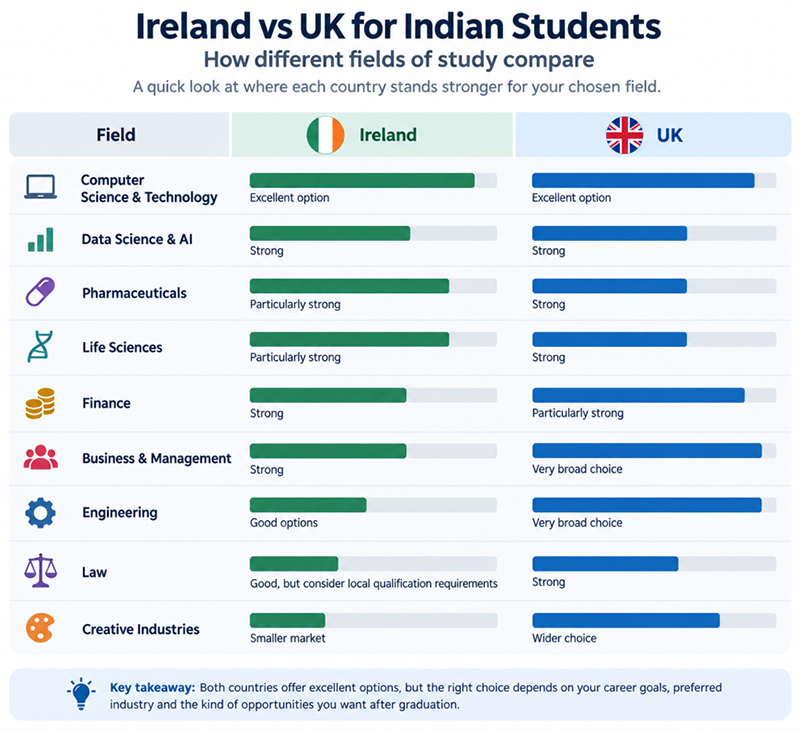
Ireland vs UK for different courses
Not every course gets the same advantage in every country. While both Ireland and the UK offer strong study options, their strengths can look quite different depending on your field. If you already have a course in mind, this quick comparison can help you see which destination may be a better fit.
Ireland vs UK: What about university choice?
This is one area where the UK has a clear advantage.
The UK has a much larger higher education sector, which means students can choose from a wider range of:
- Universities
- Courses
- Specialisations
- Locations
- Entry requirements
- Tuition fee levels
Ireland has fewer institutions, but that doesn't mean fewer opportunities.
For students who already know what they want to study, the smaller selection can actually make the search more focused.
If you are still exploring different subjects, however, the UK's wider course selection may give you more flexibility.
Ireland vs UK: Which should Indian students choose?
There is no single answer.
| The UK may suit you better if you | Ireland may suit you better if you |
|---|---|
|
|
Ireland and the UK both offer Indian students access to internationally recognised education, diverse career opportunities and exposure to global workplaces.
The UK stands out for its scale, university choice and range of courses, while Ireland offers a strong environment for technology, pharmaceuticals, life sciences and financial services.
Ireland can also be particularly appealing to eligible master's graduates because its current Third Level Graduate Programme provides up to 24 months of post-study permission for eligible Level 9 or above graduates. The UK's Graduate visa currently provides 18 months for most eligible bachelor's and master's graduates. Ultimately, there is no universally better destination.
The right choice is the one that makes sense for your course, your budget and the career you want to build.
FAQs
Is Ireland better than the UK for Indian students?
It depends on your priorities. Ireland can be particularly attractive for technology, pharmaceuticals, life sciences and financial services, while the UK offers a wider choice of universities, courses and cities.
Is Ireland cheaper than the UK?
Not necessarily. Costs depend on your university, city, accommodation and lifestyle. Dublin can be expensive, while living costs vary considerably across UK cities.
Can Indian students work while studying in Ireland?
Yes. Eligible Stamp 2 students can generally work up to 20 hours per week during term time and up to 40 hours during specified holiday periods.
Can Indian students work while studying in the UK?
Yes. Eligible students on qualifying courses can generally work up to 20 hours per week during term time, subject to their Student visa conditions.
Which country offers better post-study work opportunities?
For eligible master's graduates, Ireland currently offers up to 24 months under its Third Level Graduate Programme, while the UK's Graduate visa currently provides 18 months for most eligible bachelor's and master's graduates.
Is Ireland good for technology students?
Yes. Ireland has a strong international technology sector and is an attractive option for students studying computing, software, data and related fields.
Is the UK better for finance?
The UK has a particularly strong finance sector, with London being one of the world's major financial centres. However, Ireland also has an established financial-services industry.
Which is better for a master's, Ireland or the UK?
Both can be good choices. The UK offers a very wide selection of master's programmes, many of which can be completed in one year. Ireland can be attractive for students interested in its key industries and its current post-study options for eligible graduates.
Can I bring my spouse while studying in Ireland or the UK?
Both countries have restrictions on student dependants. Eligibility depends on the type of course and immigration route, so students should check the latest official rules before making plans.
Should I choose Ireland or the UK based only on post-study work rights?
No. Post-study work rights are important, but your course, total cost, employment opportunities and long-term career plans should carry equal or greater weight.