



What international students are asking about studying in New Zealand ? Here’s an exhaustive set of questions that will help you get to know study abroad scenario in New Zealand.
New Zealand has great education, a safe environment, reasonable work and career options, and has become the hottest studying abroad destination particularly for Indian students.
The most asked questions regarding studying in New Zealand are included in this guide. What are the best courses? Which universities are the most prestigious? What are the different types of student visas? What is the cost of living? What are the job prospects? This guide has got it all.
Students all across the globe can discover a diversity of accredited universities with a practical courses orientation, flexible part-time work options, and viable everlasting employment prospects. Moreover, students can experience all the benefits New Zealand has to offer with regard to the lifestyle and academic balance.
1. How hospitable is New Zealand to Indian students?
Before moving abroad, one of the most common worries for students is whether or not they'll fit in when they arrive.
In many cases, New Zealand is much more welcoming to Indian students than they anticipate, with cities like Auckland, Wellington, and Christchurch having large Indian populations and numerous Indian cultural events, temples, clubs, restaurants, and support systems for students.
The majority of students indicate that New Zealanders are polite, respectful, helpful, and open-minded individuals. In addition, the calmness of life in New Zealand makes it easier for international students to become emotionally settled.
Most universities provide international student support, career advice, academic assistance, mental health services, and cultural activities in order to help students adjust quickly and feel comfortable.
2. How do New Zealanders treat their immigrant students, especially Indian ones?
Questions about racism and inclusion, as well as how everyday life is like, are common among students who want to study in New Zealand.
Generally speaking, when international students talk about Kiwis, they describe them as friendly, respectful, and often very private/low-key. The universities do a lot to encourage inclusion and the public systems are set up to promote that, too. Additionally, there are Indian communities already established in many of the larger towns/cities.
However, it can take some time to integrate socially; generally speaking, Kiwis tend to be more reserved than people from India. Therefore, those who participate in sports, clubs, volunteer activities, group projects (or as part of their studies), or attend cultural events can expect to adjust sociably and professionally much quicker than those who don’t.
3. What is being a student in New Zealand like? Are there good job prospects in the technology field after people complete a master's program?
Many students from New Zealand say they feel like they have a much more relaxed lifestyle than what they experienced while attending university with their class sizes typically smaller, and more attention given to practical based learning that takes place within the classroom.
There appears to be a high demand for Tech Professional Studies such as Software Development, Cyber Security, Cloud Computing, A.I. & Data Science and UI/UX in both Auckland and Wellington.
Because of the smaller size of New Zealand's job market compared to Canada or Australia, internships, networking opportunities, practical experiences (e.g., work placement), and effective communication will play an essential role in securing employment following your graduation.
4. What is student life really like in New Zealand, and are there good job opportunities after a master’s in tech?
In New Zealand, students generally agree that the university experience is more relaxed and balanced compared to other countries due to factors such as fewer students per class and more emphasis on learning by doing (rather than only through lectures).
Tech students can expect high demand in Auckland and Wellington for roles in Software Development, Cyber Security, Cloud Computing, AI & Data Analytics and UI/UX.
With the size of the New Zealand job market being less than that of Canada or Australia, the importance of internships, networking, practical experience and communication skills for securing employment after graduation cannot be underestimated.
5. If you want to Study in New Zealand, but you are struggling to afford it - What can you do?
Financing study abroad is often the most difficult aspect of the experience for many students.
Though New Zealand is expensive, it is often more affordable than other locations such as the United States, UK, or Australia.
For many students, financing their study abroad experience is often the biggest emotional challenge throughout their study abroad process.
The positive news is that New Zealand is sometimes less expensive than the United States, United Kingdom, and Australia.
Financial planning should include emergency buffers instead of depending entirely on part-time income.
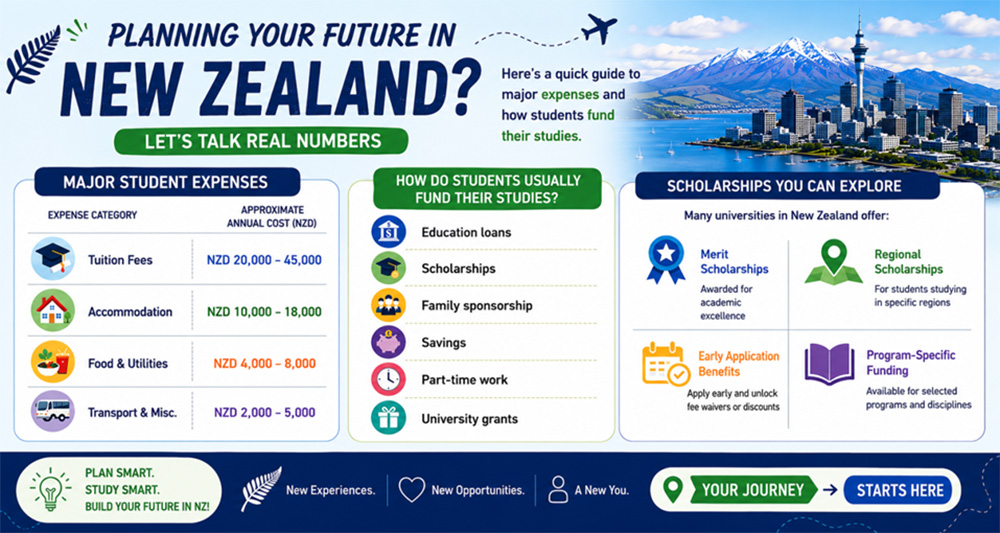
6. How much does it cost to study in New Zealand including living expenses?
Many factors determine the total cost for international students studying in New Zealand: the university they choose to attend, the city where their school is located, and their chosen lifestyle. In addition to tuition fees, international students incur the costs of housing, groceries, transportation, health insurance, and other personal expenses.
When creating budgets for study abroad trips, international students often forget to consider living expenses.
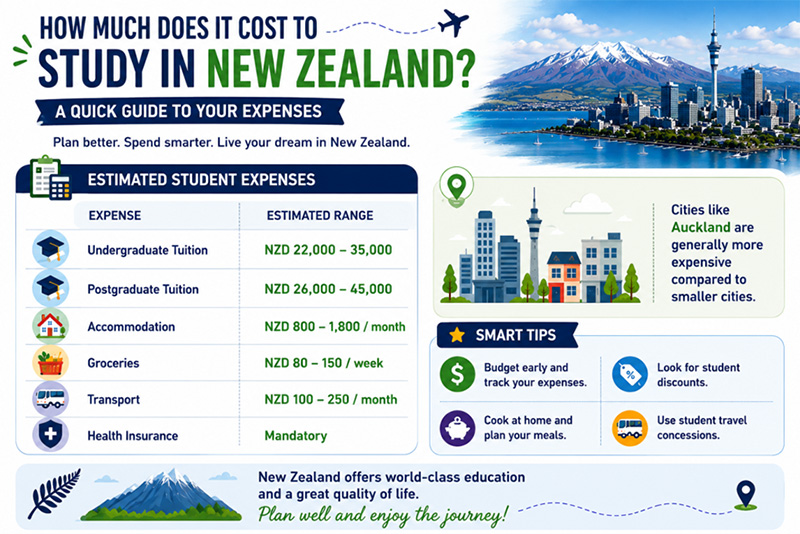
Students who share accommodation, cook at home, use student discounts and work part-time responsibly can manage expenses significantly better.
7. Is it possible for an international student to work part-time whilst studying in New Zealand to pay their living costs?
International students in New Zealand are allowed to work part-time while studying and many do this to help pay for their living costs.
Most eligible international students in NZ can
- Work 25 hours/week during study
- Work full-time during holiday breaks

A part-time job can help you cover your costs such as grocery costs, transport costs, rent contribution and personal expenses
International students should not assume that they will earn enough in their part-time job to pay for their tuition fees.
8. I am an Indian student applying for an education loan and getting sponsorship from India to study in NZ. What are the chances of getting a student visa??
Generally, a lot of Indian students apply for a NZ student visa using a combination of school loans and financial sponsors. In general, if your documentation is completely in order and your finances are simply reconcilable, your visa application will be successful.
The following combined means allow of several international students to obtain a student visa for New Zealand:
- Loans for students
- Sponsors / Funding
- Evidence of total financial need
Immigration authorities typically evaluate the following elements when evaluating eligibility
- Real intention as student consistency with prior studies
- Ability to pay
- Documentation quality
- Relevance of the course of study
Typically required supporting documentation include
- University’s offer letter
- Evidence of funds
- Letter of sanction from loan provider
- Sponsor's documentation
- Academic record
- Evidence of proficiency in English
- SOP (Statement Of Purpose)
In general, good documents and well-demonstrated finances will greatly boost the chances of getting a visa.
9. How much bank balance is needed for New Zealand student visa?
Financial proof is one of the most significant components of the New Zealand student visa procedure.
Students must prove they can truly afford to cover both tuition fees and living costs while they are here.
Proof of finances is one of the most significant sections of New Zealand student visa process.
Students often need to show:
- Support for tuition fees
- Cost of living assistance
- More emergency money if possible
Immigration policies do change from time to time thus students should constantly check updated requirements before making an application.
Financial proof may include:
- Bank statement
- Education loan sactioned
- Time deposits
- Proof of income of Sponsor
- Letters of scholarship
It's not just about having enormous abrupt deposits. It's about consistency and clarity in financial papers.
10. Do you require IELTS to go into New Zealand or are there other options?
IELTS is the most essential English language test students take for admission to New Zealand institutions. Some universities have different forms of English proficiency assessment.
English requirements are different depending on the following:
- University
- Programme level
- Course Category
- Student’s nationality
Tests often accepted include:
- PTE Academic
- TOEFL iBT type
- IELTS
- Duolingo (in some schools only)
Also, several colleges may allow students to waive an English proficiency test if they have a good academic record.
However, students should contact the university to verify this exemption and hence should always check with the university directly or the official admissions office to verify.
11. What courses are likely to help you get work in New Zealand?
There are numerous practical hands-on courses available around New Zealand that closely match the needs of the workforce and the labour market. When choosing a course to study in New Zealand, please consider the following items:
- Your Employment Objectives
- Current demand in your industry
- Existing skill shortages in your industry
- Your Long-term Migration Strategy
- Your Strengths
Your course selections should align with each of the above criteria.
12. Which courses in New Zealand provide the most prospects for PR?
Most students doing research about NZ will eventually pose the same question:
- Which course(s) would improve my chances of getting PR?
The key question students normally ask is:
- “What is the best way to get the most chance at residency?
The reality is that PR policies are not static
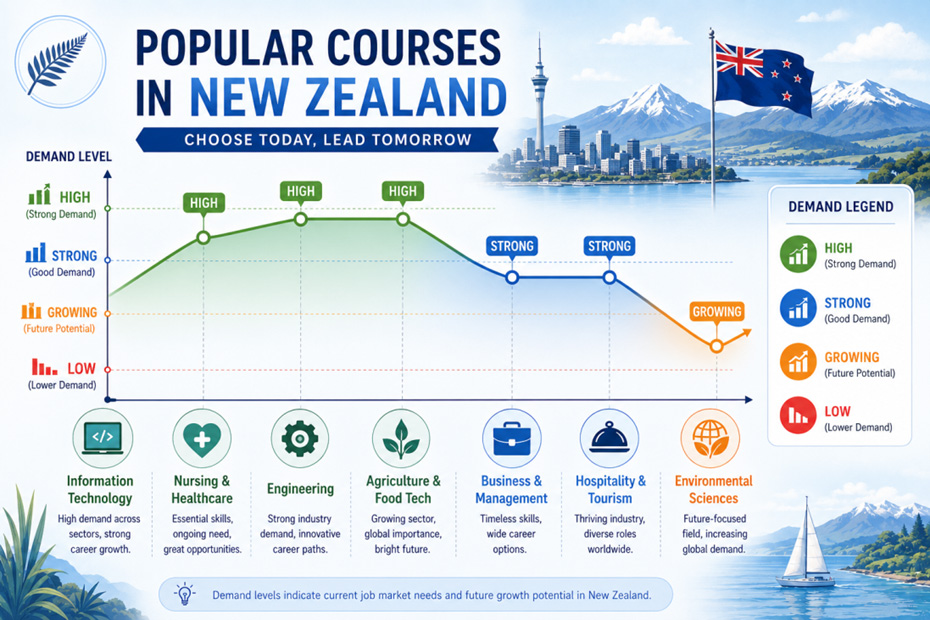
Still, industries/areas of study that commonly remain relevant are
Popular employment areas
- Health, Construction, Engineering
- Information Technology & Softwares
- Agriculture, Education, Infrastructure
Students are advised not to select courses merely for the sake of Permanent Residency.
13. Which university is the best in New Zealand?
There isn't one "top" university for every student.
What makes up the right university is a matter of course, what you want to study, where do you think you would like to live and most significantly how well you are supported by a university while you learn. In addition, there are many more elements to consider in selecting the ideal university such as academic/research credentials, student assistance and employability criteria.

14. Will I be able to find a job easily after studying in New Zealand?
Is it possible to find a work in NZ after graduation? Certainly it is, however students do need to be realistic about accomplishing this. If you want a job in today’s job environment, simple degrees aren’t going to cut it anymore.
Many students think that studying abroad will automatically guarantee them work. Unfortunately, this is not as easy as it seems.
Typically, successful candidates for employment after graduation will have secured internships in their study programme, improve their communication skills, regularly networking with industry professionals, gain relevant local experience through either work placements in NZ or through an internship abroad and have an open mind and been flexible with regards to their initial job search.
Industries seeking graduates are technology, healthcare, construction, logistics, hospitality, education and agriculture.
In general, these are the types of people NZ employers are looking for
- Hands-on skills
- Dependable
- Flexible
- Good at speaking and writing
- Working together
Students who regularly use their university's career services will typically have an advantage over those who don't.
15. Why is New Zealand being considered by more students in 2026?
Some people think of New Zealand as the "hidden gem" when it comes to studying abroad.
New Zealand doesn't overtly promote itself as a top destination for international students yet many are seeing the benefits and are drawn to New Zealand.
For students not looking at rankings, social media etc. New Zealand is often a highly personal decision and not just a job option.
New Zealand is a place where students can thrive, and continue their education while enjoying the natural beauty of the landscape and experiencing what a modern infrastructure has to offer, along with a safe and diverse community to be a part of.
New Zealand is a great place for practical, adaptable, scholarly, open-minded students to explore the culture and the environment while creating long-term skills.
For many students, New Zealand is not only a place to study, but a place to take time for themselves and to grow as individuals.
When it comes to studying abroad, selecting which university to attend is not the only consideration. You also need to think about the type of life you want to create, atmosphere you wish to have, potential career paths you will have and the person you aspire to become.
There are very few other nations that can offer all of these perks. When you think of things like PR options, high quality education, low crime rates, a good quality of life and job chances for the future , New Zealand has something for everyone.
The key is to be wise about how you move forward with your strategy, knowing which programs can assist you achieve your objectives and entering into each stage of this trip prepared versus having expectations of what will take place.
After completing your studies in New Zealand, you should have changed your life for the better.