


Top 10 Courses in Dubai for Indian Students in 2026 - Ranked by Career Demand
Dubai runs branch campuses of top British, Australian, and American universities. That part, you probably already knew. What most guides skip: the job market here has real, documented gaps — tech, engineering, finance, sustainability, all short on skilled hands. For Indian students, that gap is a door. But only if you pick the course that actually walks through it. This guide ranks the top 10 most popular courses, not by which name sounds impressive, but by verified UAE hiring data. And here's what most articles won't tell you upfront: Dubai has no automatic post-study work permit. Read the first section before you read anything else — it changes how you should judge every course on this list.
10 Most Popular Courses in Dubai that Indian Students are going for: Where the Jobs Actually Are in 2026
Every other Dubai guide opens the same way: proximity to India, tax-free pay, campuses full of forty nationalities. None of it's false. All of it's recycled. None of it tells you whether you'll actually have a job when the degree's done.
This one starts with numbers instead. Workforce numbers. Because two to four years and a real chunk of savings buy more than a campus tour — they buy a shot at employment, or they don't.
Study in Dubai isn't a decision you make on vibes. Treat it like one that costs real money. Because it does.
Before You Pick a Course - What Indian Students Need to Know About Working in Dubai
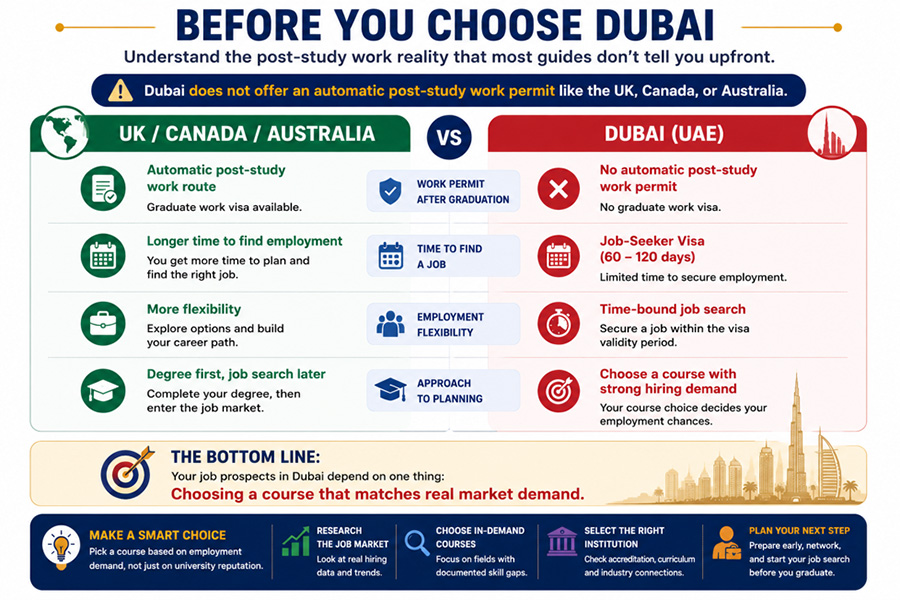
Here's the fact most Dubai guides bury or skip outright. Dubai has no automatic post-study work permit. The UK hands you a Graduate Route visa. Canada hands you a PGWP. Australia has its Temporary Graduate visa. Finish your degree in any of those three, and the paperwork follows. Dubai doesn't work that way.
What you get instead is a job-seeker visa. Sixty to a hundred and twenty days, tops. For students heading into fields where employers are short-staffed — tech, engineering, finance - that window is usually enough. Recruiters in those spaces are chasing candidates, not the reverse. Land in a crowded field, though, and that same window turns into a countdown.
None of this is a reason to skip Dubai. It's a reason to be picky about the course. Every entry below tells you straight whether your field gives that visa window a fighting chance.
Not sure where you fit? Speak with a Global Reach counsellor before you shortlist anything.
How We Ranked These Courses - The Skill Gap Logic
One question drove this whole ranking: where is the UAE job market is actually short-staffed, right now?
We pulled from UAE Ministry of Human Resources and Emiratisation workforce data, KHDA's higher education reports, the World Economic Forum's Future of Jobs Report 2025, and hiring intelligence straight from the agencies placing people in these roles.
72% of UAE firms expect the skills gap to slow them down. Nearly half of on-the-job skills - 46% - are projected to shift entirely by 2030. Few places on earth are turning over that fast. And 87% of UAE companies are bracing for a spike in demand for tech-literate hires specifically.
Courses near the top have harder, more citable demand evidence behind them. The ones further down aren't weaker choices. Their evidence is just thinner.
So, what are the top trending courses in Dubai for Indian students?
The Top 10 Courses in Dubai for Indian Students - Ranked by Demand
| Rank | Course | Career-demand signal | Job-seeker visa risk |
|---|---|---|---|
| 1 | AI & Machine Learning | Fast-growing AI and data roles across UAE digital transformation programs. | Low |
| 2 | Data Science & Business Analytics | High demand across finance, logistics, retail, healthcare, and real estate. | Low to medium |
| 3 | Cybersecurity & Cloud Computing | Strong need for specialists as cyber threats and cloud adoption increase. | Low |
| 4 | Engineering - Civil, Mechanical & Electrical | Infrastructure investment and construction activity support sustained hiring. | Low |
| 5 | Sustainability & Renewable Energy Engineering | UAE clean-energy targets are increasing demand for energy-system expertise. | Low to medium |
| 6 | Finance & Fintech | DIFC growth and fintech adoption are driving specialist finance hiring. | Low to medium |
| 7 | MBA - General & Specialised | Strong business-course demand, but outcomes depend on experience and specialisation. | Medium |
| 8 | Digital Marketing & Media | Broad demand across e-commerce, tourism, real estate, and retail. | Medium |
| 9 | Hospitality & Tourism Management | Dubai’s visitor-economy growth supports hospitality and events careers. | Low to medium |
| 10 | Healthcare Management | Healthcare, wellbeing, and medical-tourism growth create demand for management talent. | Medium |
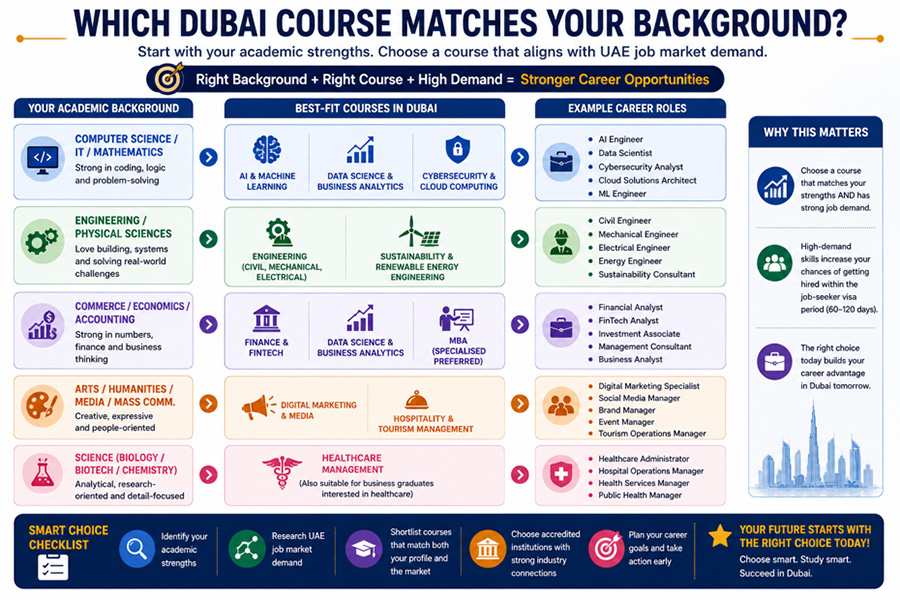
1. Artificial Intelligence and Machine Learning
Demand signal: AI careers in the UAE grew 48%, data scientist hiring grew 43% — both between 2024 and 2025.
Best for: Engineering or computer science graduates with strong quantitative ability.
Job-seeker visa risk: Low. Employers in this field are competing for candidates, not the other way around.
These aren't forecasts. This is what's already being hired. Abu Dhabi has put AED 13 billion behind its 2025–2027 Digital Strategy, aiming to run government services on AI end to end — 200 initiatives, all government-backed, all multi-year. Dubai's own AI roadmap rides on that same wave.
For an Indian student coming out of a B.Tech or B.Sc in Computer Science, the jump into an AI or Machine Learning postgrad here is a well-worn path. Dubai institutions know exactly what to do with that background.
Heriot-Watt University Dubai runs postgraduate AI and data programs tied closely to the UAE's national tech agenda. Middlesex University Dubai teaches the same space with a curriculum built around actual industry practice.
2. Data Science and Business Analytics
Demand signal: UAE's digitalisation drive has created a specific shortage of professionals who can translate data into business decisions across every major sector.
Best for: Commerce, mathematics, economics, or computer science graduates. Strong for working professionals adding analytical capability to a business career.
Job-seeker visa risk: Low to medium. Strong demand but broader competition than pure AI roles.
Real estate. Retail. Logistics. Finance. Healthcare. Every one of them is racing to build data capability, and none of it sits quietly inside an IT department anymore. This is a business skill now. Dubai pays for it like one.
SP Jain School of Global Management has carved out a name in business analytics - technical chops paired with commercial instinct, which is exactly the combination Dubai employers keep asking for. University of Wollongong Dubai backs its programs with Australian accreditation and placement networks that already have doors open.
3. Cybersecurity and Cloud Computing
Demand signal: 200,000 cyberattacks happen in the UAE every day. The local talent pool does not have specialist expertise at sufficient scale to counter AI-driven threats.
Best for: Computer science or IT graduates. Also relevant for IT professionals who want to specialise.
Job-seeker visa risk: Low. Qualified candidates are being competed for actively.
This isn't a demand spike that fades. Dubai's financial systems, government infrastructure, and smart-city rollout keep expanding - and every inch of that expansion is more surface area for attackers. Walk into this field right now, and the leverage sits with you, not the employer.
Study in Dubai for cybersecurity, specifically, beats studying somewhere the graduate pool is already flooded and your edge gets lost in the crowd.
Heriot-Watt University Dubai offers postgraduate routes here. Middlesex University Dubai folds cybersecurity into its computing programs at both undergraduate and postgraduate levels.
4. Engineering - Civil, Mechanical and Electrical
Demand signal: Dubai's 2025 budget allocated 46% to infrastructure. AED 66 billion committed to 144 construction projects across the UAE. Skilled engineers are in documented short supply.
Best for: Science and mathematics students for undergraduate entry. Engineering graduates for specialised postgraduate programs.
Job-seeker visa risk: Low for infrastructure and sustainability specialisations.
Engineering breaks the pattern here. It's the one field where an undergraduate degree carries as much weight as a postgraduate one. A recognised engineering degree walks straight into the UAE's construction and infrastructure sectors — no detour needed.
University of Birmingham Dubai, the first Russell Group campus in the city, brings accreditation that government contractors and multinationals look for. BITS Pilani Dubai is UGC-recognised, which matters if India stays on the table. Curtin University Dubai adds Australian accreditation with industry ties already built in.
5. Sustainability and Renewable Energy Engineering
Demand signal: UAE Energy Strategy 2050 targets tripling renewable energy share by 2030. The gap between ambition and available skilled workforce is government-acknowledged.
Best for: Engineering or physical sciences graduates with an interest in energy systems and environmental impact.
Job-seeker visa risk: Low to medium. Growing fast but a smaller hiring pool than mainstream engineering.
People who understand both renewable systems and the regulation wrapped around them are rare anywhere. In the UAE, they're being pulled straight into government-linked projects and private energy firms alike. Rare skill, real hunger for it.
Heriot-Watt University Dubai runs one of the more established sustainability and energy programs in the region. University of Birmingham Dubai weaves sustainability into its engineering and applied science offerings.
6. Finance and Fintech
Demand signal: UAE finance sector specifically seeking fintech experts as a priority hiring category. Fintech jobs hit record highs in 2024 with salary gains reflecting candidate competition.
Best for: Commerce or economics graduates. Working professionals in banking or accounting targeting a fintech transition.
Job-seeker visa risk: Low for fintech specialists. Medium for general finance roles.
Dubai's position as home to the Dubai International Financial Centre (DIFC) - one of the world's leading financial centres - creates sustained demand for finance professionals. The fintech layer on top of that traditional base is where the acute shortage sits.
SP Jain School of Global Management has a strong reputation in finance with direct industry connectivity in the UAE market. Hult International Business School Dubai combines finance with a global business perspective suited to Dubai's internationalised financial environment. Canadian University Dubai offers finance programs with North American curriculum standards.
7. MBA - General and Specialised
Demand signal: 54% of international students in Dubai study business programs — the single largest category. Strong demand but also the most competitive graduate pool.
Best for: Working professionals with two or more years of experience. Not recommended for fresh graduates — Dubai MBA employers consistently prefer experienced candidates.
Job-seeker visa risk: Medium. Supply of MBA graduates is high. Specialisation and institution quality determine outcomes.
The MBA sits lower on this list. Not because nobody wants one - because everybody has one. Supply caught up with demand a while ago. A specialised MBA - supply chain, digital business, healthcare management, luxury brands - beats a generalist one every time in Dubai's sector-driven economy.
Hult International Business School draws a genuinely global cohort that fits Dubai's multinational hiring pool. SP Jain School of Global Management has alumni threaded through the UAE already. Manipal Academy of Higher Education Dubai and Amity University Dubai carry Indian university recognition - worth something if a return to India is even a backup plan.
8. Digital Marketing and Media
Demand signal: Broad demand across e-commerce, real estate, tourism, and retail - but more graduates competing than in technology or engineering fields.
Best for: Arts, commerce, or humanities students. Strong fit for those with existing content or social media experience.
Job-seeker visa risk: Medium. Platform-specific expertise beats general marketing qualifications in Dubai's hiring market.
Generic marketing degrees don't move the needle here. What does: SEO chops, paid media strategy, content analytics, social commerce - the stuff you can point to and prove. A program that teaches tools alongside theory wins out over one that stops at theory.
Middlesex University Dubai runs a media and communications faculty with real ties into the city's creative and digital sectors. University of Wollongong Dubai builds in practical project work. SAE Dubai leans into creative media production - the right call if your interest is making content, not strategizing around it.
9. Hospitality and Tourism Management
Demand signal: Dubai targeted 40 million annual visitors by 2031. Hospitality is consistently flagged in GCC skills training reports as requiring structured professional development.
Best for: Students who genuinely enjoy service environments and customer-facing roles. Not a course to choose by elimination.
Job-seeker visa risk: Low to medium. Strong placement networks at the right institutions make a significant difference.
Here's the edge for Indian students specifically: Dubai's hotel and events infrastructure is about as developed as it gets anywhere on the planet. That means internships and placements during your course aren't a nice-to-have. At the right institutions, they're baked in.
Heriot-Watt University Dubai runs a hospitality program with industry ties built over its long stretch in the UAE. EM Normandie Business School Dubai brings a European hospitality lens - worth a look if luxury hotels or international chains are the goal.
10. Healthcare Management
Demand signal: Dubai's National Strategy for Wellbeing 2031 targets UAE leadership in health tourism — impacting 40 priority healthcare areas. Business-side healthcare professionals are in short supply.
Best for: Science graduates interested in healthcare administration, or business graduates wanting to specialise in a high-growth sector.
Job-seeker visa risk: Medium. Growing sector but fewer institutions offer strong programs compared to technology fields.
Healthcare Management lives where business meets medicine - operations, finance, compliance, digital health. Coming from a science background heading into administration? This fits. Coming from business and chasing a sector that's actually growing? Same answer.
University of Birmingham Dubai tucks health-related programs into its applied science and management faculty. Middlesex University Dubai runs healthcare-adjacent tracks - health sciences, public health, that lane.
One Check Every Indian Student Must Do Before Applying
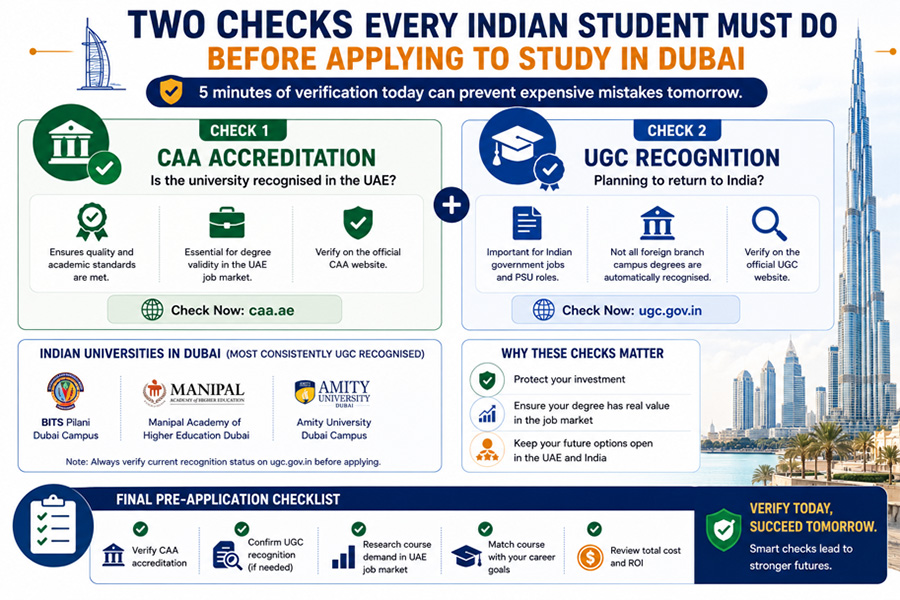
Two checks. Five minutes each. Skip the ranking table if you have to - don't skip these.
First: pull up the CAA accredited institutions list at caa.ae and find your university on it. Not there? The degree means nothing in the UAE job market, full stop.
Second: if India stays on the table, even as a fallback, check UGC recognition at ugc.gov.in. BITS Pilani Dubai, Manipal Academy Dubai, and Amity University Dubai are the names that show up reliably on that list. Most private employers in India will take a UK or Australian branch-campus degree without blinking. Government jobs and PSU roles won't - not automatically.
Run both checks before the deposit leaves your account. Not after.
How Global Reach Can Help You Choose the Right Course in Dubai
Demand data tells you where the jobs are. It doesn't tell you whether you belong in that field, or whether your finances and timeline can carry the plan through. That part's a different conversation.
Global Reach has spent 35 years walking Indian students through exactly this kind of decision. For Study in Dubai, that means lining up your profile against the right course, the right institution, and the right accreditation - whether you're staying in Dubai, heading back to India, or using this degree as a launch pad to somewhere else.
Conclusion
Skip the skyline. Skip the flight time from India. Skip the tax-free salary pitch - that last one depends entirely on which field you pick and how fast you land a job once the visa clock starts ticking. The real reason to study in Dubai is the skill shortage. Everything else is décor.
AI, Data Science, Cybersecurity, Engineering - these sit at the top because the employment case is strongest right now, no asterisks. Everything further down the list still works. It just asks more of you: the right institution, the right specialisation, because the field name alone won't carry you.
Most students get the order backwards. University first, course second - pick a name they've heard of, then bend a course to fit it. Flip that. Find where the demand actually is, then go hunt for the strongest program teaching it. That's the sequence that gets people hired faster.
Want a straight read on where your profile lands? Speak with a Global Reach counsellor. Thirty-five years of doing this for Indian students means the advice comes from pattern recognition, not a spreadsheet.
FAQs most popular courses in-demand in Dubai for Indian Students
Q1: Which course in Dubai gives the best salary for Indian graduates?
AI and Machine Learning, Cybersecurity, and Data Science consistently command the highest starting salaries in Dubai's current market - reflecting the acute skill shortage in these fields. Engineering salaries vary by specialisation but are strong in infrastructure and sustainability roles. MBA salaries depend heavily on prior work experience and the institution attended. Salary follows demand, and demand follows skill shortage - which is why the ranking in this article is built around workforce data rather than course popularity.
Q2: Is an MBA from Dubai worth it compared to UK or Australia?
For students planning to work in the Middle East after graduating - yes, with the right institution. Dubai MBAs from recognised institutions like Hult, SP Jain, or Heriot-Watt carry weight in UAE and regional job markets, and the cost is significantly lower than equivalent UK programs. For students planning to return to India or move to a Western country, a UK or Australian MBA carries broader recognition. The answer depends on where you plan to build your career, not on which degree sounds more prestigious.
Q3: Does Dubai have a post-study work permit for international students?
No - and this is the most important thing to know before choosing Dubai over other destinations. Dubai does not offer an automatic post-study work permit the way the UK, Canada, or Australia do. What Dubai offers is a job-seeker visa valid for 60 to 120 days after graduation. During this period, you can legally remain in the UAE and search for employment. For graduates in high-demand fields - AI, cybersecurity, engineering - this window is often sufficient because employers in these sectors are actively recruiting. For graduates in more competitive fields, the timeline is tighter and advance job-search preparation during your final semester is not optional, it's essential.
Q4: Are Dubai university degrees recognised in India and globally?
It depends on the institution and your plans after graduation. Globally recognised branch campuses - University of Birmingham Dubai, Heriot-Watt University Dubai, Middlesex University Dubai, Curtin University Dubai - carry the same accreditation as their home campuses and are recognised by international employers. For Indian government employment or PSU roles, UGC recognition is the relevant check. BITS Pilani Dubai, Manipal Academy Dubai, and Amity University Dubai are the Indian branch campuses most consistently verified as UGC-recognised. Always verify before paying a deposit - not after.
Q5: What is the minimum eligibility to study in Dubai for Indian students?
For undergraduate programs, most Dubai universities require a minimum of 60% in Class 12, with competitive programs requiring 65% or higher. English proficiency is required - typically IELTS 6.0 minimum, though requirements vary by institution and program. For postgraduate programs, a relevant bachelor's degree with a minimum of 55–60% is the standard baseline, with work experience increasingly valued for MBA programs. Always check program-specific requirements on the university's official page.
Q6: Can Indian students work part-time while studying in Dubai?
Yes, with conditions. Indian students in Dubai can work up to 15 hours per week during semester and full-time during academic breaks. Students must be at least 18 years old, hold a valid student visa, and obtain work approval from both the university and the UAE Ministry of Human Resources. On-campus jobs, retail, tutoring, and hospitality roles are the most accessible sectors. Part-time income in Dubai covers supplementary living costs - it does not cover tuition fees.
Q7: How do I know if a Dubai university is accredited by KHDA or CAA?
The Knowledge and Human Development Authority (KHDA) oversees private education in Dubai specifically. The Commission for Academic Accreditation (CAA) covers degree quality across the UAE. Both maintain publicly searchable lists on their official websites. Search for your institution on the CAA accredited institutions list at caa.ae before applying. This check takes five minutes and protects you from a degree with no standing in the UAE job market.
Q8: What is the job-seeker visa in Dubai and how does it work for graduates?
The job-seeker visa allows recent graduates to remain in the UAE for 60 to 120 days after completing their degree to search for employment. Once you receive a job offer, your employer converts your status to a work visa. The job-seeker visa is not renewable - if you do not secure employment within the validity period, you must leave the UAE. Graduates in high-demand fields should begin their job search during their final semester rather than waiting until after graduation.
Q9: Which Indian universities have recognised campuses in Dubai?
Several Indian universities operate campuses in Dubai within Dubai International Academic City. BITS Pilani Dubai, Manipal Academy of Higher Education Dubai, Amity University Dubai, Symbiosis International University Dubai, and Jaipur National University Dubai are among the established Indian campuses. BITS Pilani Dubai, Manipal Academy Dubai, and Amity University Dubai are the ones most consistently verified for UGC recognition. Verify current status at ugc.gov.in before applying.
Q10: How much does it cost to study in Dubai compared to the UK or Canada?
Annual tuition fees at Dubai universities range from approximately AED 37,500 to AED 1,50,000 depending on the institution, program level, and field - roughly INR 9.5 lakhs to INR 38 lakhs per year. Living costs add approximately AED 21,000 per year - around INR 4.7 lakhs. The total cost of studying in Dubai is typically 30-40% lower than a comparable UK program, though this advantage narrows if employment after graduation takes longer than the job-seeker visa allows.
*Information in this article reflects data available at the time of writing. Course availability, tuition fees, and accreditation status are subject to change. Always verify directly with the institution before making application decisions.
Content Authored by:

Supriya Acharyya is the Assistant Vertical Head for Dubai & Asia at Global Reach. With over 10+ years of experience in the international education sector she is an international education professional specializing in business development, student engagement, admissions, and academic operations. Driven by a student-first approach, she is passionate about guiding aspiring students towards informed decisions and successful study abroad journeys.