



Study in Australia: Tuition Fees, Living Cost, Scholarships, Job Prospects, New Visa Rules, Everything Explained
Australia is a very popular destination to study for many international students as it has top-ranked universities, quality of life, employment opportunities after graduation (post-study) and multicultural population. But with living costs rising, visa rules tightening and immigration laws altering, overseas students will have to be well prepared for this option. The following guide provides the list of crucial questions with answers to aid international students to know whether they want to study in Australia. This includes the cost of study, scholarships, career options after graduation, permanent residency (PR) opportunities and new visa requirements.
1. Is studying in Australia still worth it for international students?
Australia continues to be one of the most popular international education destinations in the world and its attractiveness is not limited to post-study work opportunities.
Australian universities are always highly ranked in world rankings and the country has a strong reputation for research, technology and innovation.
In the 2026 QS World University Rankings by Subject: Australian universities among the world’s top 100 for 54 subjects.
That reputation is backed up with some impressive Australian innovations.
Wi-Fi technology is an Australian invention - a CSIRO creation.
Australia also gave the world the Bionic Ear, revolutionizing hearing technology globally.
Depending on their visa conditions, students may also be able to work while they study and there are post-study work options for eligible graduates. Important sectors still include healthcare, engineering, technology, construction, education, and professional services.
Of course, it’s not cheap to study in Australia. Tuition fees, accommodation, health insurance and day-to-day living costs need to be considered. The 2026 National Planning Level of 295,000 is also part of Australia’s approach to managing international student growth but it is not a cap on the total number of students.
Is Australia still worth it? Yes, if the university, the course, the costs and the career goals are right. The most important reason to study in Australia should be the opportunity to get a good education, experience innovation and opportunities through the right course and not just the opportunity to stay on as a permanent resident.
2. Safety as an International student
One important consideration when moving overseas is safety. Australia is generally a stable country with a peaceful lifestyle and is not currently involved in any armed conflict on its own soil.
It also has strict firearm laws. Under Australia’s national framework, gun ownership is tightly regulated, with licensing, a genuine reason for ownership, safety training and firearm registration required.
International students also have special protections. The ESOS framework sets national standards that education providers must meet and protects international students thru provisions relating to education quality, student rights and tuition protection.
In an emergency students can contact police, fire or ambulance services by dialing Triple Zero (000). Most international students are also required to have Overseas Student Health Cover (OSHC) for the duration of their stay.
From January 2026, a new national framework will require higher education providers to take steps to prevent and respond to gender-based violence, including appropriate support and reporting mechanisms.
That doesn’t mean students should stop being careful, though basic precautions still matter. Be aware of your surroundings, especially at night. Keep important documents secure. Save your university’s emergency and student-support contacts.
To summarize, Australia has the stability, regulation and student support systems you’d expect from a major international study destination – but students do still need to take sensible precautions.
3. Any tips on how to settle into Australia well as an international student?
The best approach to settle in is to get the critical practical items organised before courses start. Housing needs to be a top priority, particularly in areas where there is strong demand for rentals. If you can't find a long-term residence before you arrive, arrange interim lodging and give yourself time to look at properties before signing a lease.
When you get there, apply for a Tax File Number (TFN) if you plan to work. Applying through the Australian Taxation Office is free and without one your employer may not tax you correctly. You should also have a local bank account and phone number as these are generally required to carry out day to day transactions.
Another early lesson is the public transport. Australia’s largest cities have separate systems like Opal in NSW, Myki in Victoria, Go Card in Queensland, SmartRider in Western Australia and MetroCARD in South Australia. Student concessions vary by regions and eligibility, so verify with the local transit authorities rather than assuming the same discount applies everywhere.
Most important, know your
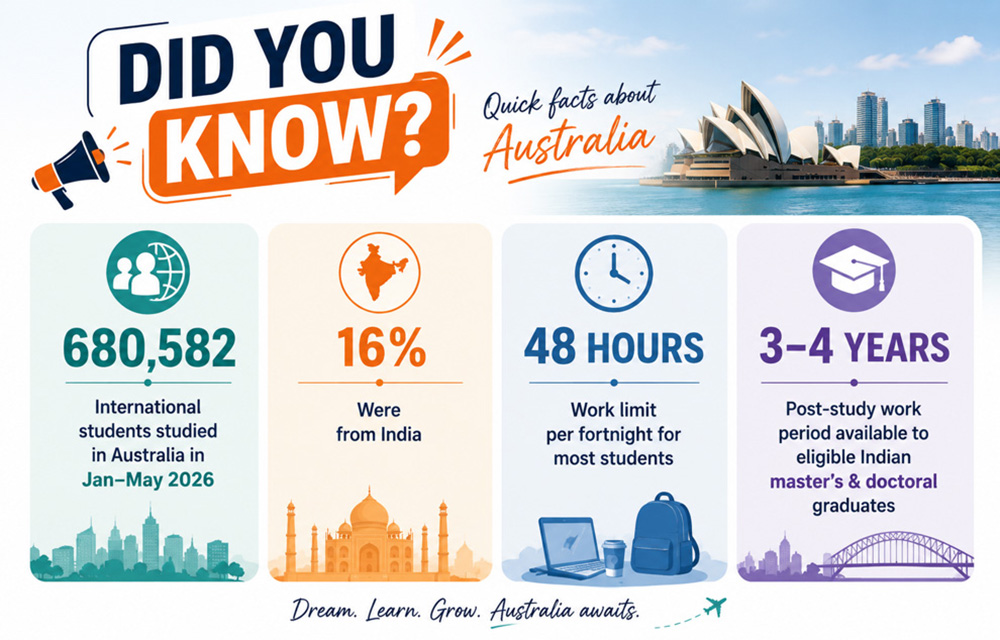
Student visa conditions before accepting a job | International students can usually work up to 48 hours per fortnight during the course.
Under the Department of Home Affairs, international students in Australia enrolled in a Master's by Research or a doctoral degree (PhD) have no limit on their work hours once their research program has officially commenced.
From the beginning, make the most of your university’s orientation and student-support programs. They can aid you in various ways such as academic support, advice on accommodation, health, wellbeing and employment services.
4. Can I work while studying in Australia as an international student?
Yes. If you’re studying in Australia on a Student Visa (Subclass 500) you can usually work up to 48 hours per fortnight while your course is in session. The 48-hour weekly limit does not normally apply to working during the scheduled breaks in the course. Current visa restrictions do not limit the number of hours students can work if they are studying for a research masters or PhD.
That means part-time work could be a good option to meet some day-to-day costs while getting Australian job experience. International students often find work in retail, hospitality, customer service, warehousing and delivery, and some may also find work thru their university.
But it’s vital to remember that part-time work does not replace the need to have sufficient income for your schooling and living expenses. Plan for your tuition fees, lodging and other important costs before you arrive.
It’s also worth remembering that Australia’s minimal employment rules apply to international students too. Employers are required to observe the requirements of Australian workplace legislation, including rules for minimum pay and working conditions.
5. How much does it actually cost to live and study in Australia for 1 year?
Your tuition costs will depend on what you study and where you study it. As a general guide, business degrees can range from around AUD 30,000–60,000 a year, engineering from AUD 40,000–60,000, while medicine and dentistry can cost around AUD 80,000–100,000 per year. Actual fees vary by university and course.
For the Student visa, the existing requirement on financial capacity is that a single student is required to demonstrate that they have AUD 29,710 a year. This is a visa benchmark and does not guaranty the actual amount of money you will spend on living costs. Your actual costs will vary depending on things like your location, your accommodation and lifestyle.
You will also need to budget for OSHC, accommodation, transport, food, utilities, personal expenses and your visa application fee. And for most primary applicants, the Student visa application charge is AUD 2,500 from 1 July 2026.
The bottom line? Don’t plan on one national average. Before you apply check the actual tuition fee of your university and do some research on the cost of living in the city you will study in.
6. What are some scholarships for international students to study in Australia?
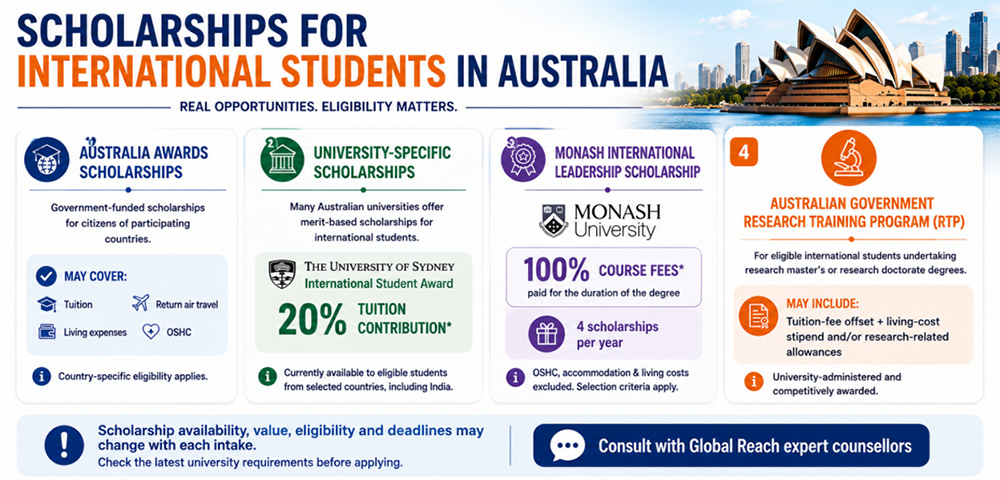
There are genuine scholarship opportunities for international students in Australia, but the amount, eligibility and availability differs by country, university, course and level of study.
The Australia Awards Scholarships are one of the Australian Government’s flagship scholarship programs. Depending on the award, they can cover full tuition fees, return air travel, establishment costs, living expenses and OSHC for citizens of participating countries, plus other support. Eligibility is country dependent and not available to all nationalities.
And then there are university-specific scholarships. For example, the University of Sydney International Student Award currently provides a 20% contribution toward tuition fees for eligible students from selected countries, including India.
Monash International Leadership Scholarship by Monash University, 100% course fee remission for selected international students. Four scholarships are awarded per year. Accommodation and living expenses not included. OSHC not included.
The Australian Government Research Training Program (RTP) provides eligible higher degree research students with support thru a tuition fee offset, living cost stipend and/or research related allowances, depending on the scholarship and the university.
7. What are the chances of getting a job in Australia after graduation?
There are jobs available in Australia after graduating however a degree by itself does not ensure a job. The 2025 Graduate Outcomes Survey which surveys graduates about four to six months after completing their studies, revealed that 52.5% of international postgraduate coursework graduates from Australian institutions were in full-time employment and 69.7% were in some sort of employment. The full-time employment rate for international university undergraduates was 50.5%, and the total employment rate was 69.7%.
Indian graduates get extra year of PSW
The course you choose counts, because Australia’s employment market isn’t developing equally across all areas.
Jobs and Skills Australia estimates health professionals and ICT professionals as some of the strongest-growing occupation groups over the next decade, while Health Care and Social Assistance is anticipated to achieve the strongest employment growth of any industry.
Eligible graduates can apply for the Temporary Graduate visa (subclass 485) to obtain Australian work experience after finishing their education. Graduates who meet the requirements and studied at an approved regional institution may additionally qualify for a second post-higher education employment period of one to two years, based on the regional location.
The bottom line for parents is simple: don't judge a course just by its job prospects. Check the occupation, the existing demand for employment, course material, work experience opportunities and realistic career path of the graduate.
8. Which city in Australia is best for international students - Sydney, Melbourne, Brisbane, Perth, or Adelaide?
There’s no single best city for all students. Which one is preferable depends on what you want to study, your budget and where you want to build your career. There are now 42 institutions in Australia and the major international student hubs are spread across all five cities.
Sydney is a good alternative for students interested in business, finance, technology and professional services. NSW describes Sydney as Australia’s financial powerhouse and is placed among the world’s Top 10 student cities in the QS Best Student Cities 2026 rankings.
Melbourne has a solid offering in business, health, engineering, technology and creative fields, and is especially appealing to students seeking a large university and student community.
Brisbane offers a major city experience with access to institutions and an increasing diversity of industries. It can also be worth considering for students who seek a warmer environment and a different cost of living profile than Sydney or Melbourne.
Brisbane has another advantage on the horizon: the 2032 Olympic and Paralympic Games. The long-term build-up is expected to create opportunities across construction, technology, hospitality, logistics, professional services and events, with Queensland forecasting around 91,600 full-time job years associated with the Games.
Perth and Adelaide give students choosing regional study pathways a further advantage. Both are classed as Category 2 regional places under Australia’s migration classification, while Sydney, Melbourne and Brisbane are Category 1 big cities. This may enable qualifying graduates to access specific regional migration and post-study benefits.

9. What are the new visa rules for Australia for Indian students?
The old GTE requirement has been replaced by the Genuine Student (GS) requirement. Students are now required to justify their choice of course and Australia, their present situation and how the course will assist them in the future.
Students must also prove financial capacity. The current benchmark is AUD 29,710 for a single student, plus tuition and travel costs. The actual cost of living can be greater depending on the city.
The Student visa application charge changed from 1 July 2026.
You’ll be entitled to work for up to 48 hours fortnightly during semester, and for unlimited hours during the break. Master's by research and doctorate students have no time constraint.
There is more emphasis on the right evidence. Students must hold a Confirmation of Enrolment (CoE), meet financial and English criteria, maintain OSHC and comply with their visa conditions
10. How to go to Australia for studies through Global Reach?
You can begin your journey to study in Australia through Global Reach – a leading Study Abroad consultant for Australia - with a FREE counselling session where our experienced and certified counsellors understand your academic background, career goals, budget and plans for the future. We have over 35 years' experience in overseas education and long-standing relationships with Australian universities to help you explore the right course and university rather than just applying to the first option you come across.
Global Reach has over 600 institutions across the world, a strong presence in Australia with an on-ground office and has helped over 60,000 students enroll in institutions across the world.
We have a large network of universities, so there will be more options for you and our counsellors will help you weigh those options to see what works best for your goals.
After you have shortlisted your choices, our team will guide you through course and university selection, applications, scholarship opportunities, documentation, visa guidance and pre-departure preparation. So instead of having to figure out every step yourself, you have one experienced team guiding you through.
You also get the scale of a consultancy with 50 offices in 6 countries, experienced and certified counsellors and industry recognition like the PIEoneer Award and Lifetime Impact Award. Global Reach, with decades of experience and a strong Australia focus, brings the expertise, university access and end to end support to help make your journey to Australia easier, more informed and more confident.
Australia is still a popular destination for overseas students, with internationally acclaimed universities, practical learning opportunities, diverse communities and avenues to get work experience after graduation.
But studying abroad is a huge financial and career choice. Students should carefully check the course, university, total cost, scholarships offered, visa conditions and job prospects before deciding.
If students choose a degree that suits their career aspirations, understand the fees involved and prepare carefully for life and work in Australia, the country can offer a worthwhile educational and professional experience.