



Studying in the UK: All the Important Questions asked by Students & Parents about UK Study Abroad journey
International students are attracted to study in the UK for many reasons like quality education at renowned institutions, globally recognised qualifications, short duration courses compared to other countries and post-study work opportunities. However, before choosing the UK as your study destination, students should know what to expect when it comes to tuition fees, living costs, financial aid, visas, working while studying and after graduation, and other things to take in considerations. The following guide provides answers to some of the most frequently asked questions regarding studying in the UK as an international student.
Is studying in the UK actually worth it?
If you want to go to a top tier university (Russell Group or equivalent brand name) then studying in the UK is still well worth it. The worldwide prestige of these institutions is undeniable. The Master’s structure is intense but a huge advantage for one year. It fast-tracks your academic and professional development, allowing you to graduate into the skilled workforce a full year ahead of your peers in the US or Canada. This efficiency saves you an entire year of international tuition and living expenses, allowing you to reduce your overall investment significantly while increasing your immediate Return on Investment.
The academic quality and cultural experience are still world class, especially in strong areas like STEM, Finance and Data. The UK job market is great for post-study work opportunities for students in these high-demand sectors and the connections you make can set up your whole career path. It’s hard to beat the networking opportunities you get in a diverse hub like London, or an innovation hub such as Manchester or Edinburgh. The programs are intense meaning you are immersed in your subject and receive rigorous, high-level training that employers everywhere recognize.
Of course the UK isn’t as much of a guaranteed pathway as it was maybe ten years ago, and you really have to be strategic with your choices. If you want to get your money’s worth, your job from day one of university is to use all the employability resources you can, not just the brand of your degree.
The general consensus is that a UK degree, if pursued with a clear professional goal and from a top-tier university, provides an extraordinary international platform and a huge long-term advantage in the global job market. The short term challenges of visa uncertainty and rising cost of living are real, but generally manageable, especially when you arrive in the UK with a career plan.
Book a free counselling session
Will I get a job after graduation in the UK?
While no university can guarantee employment, the UK continues to offer strong career prospects for graduates across a wide range of industries.
According to Universities UK (UUK) Report, September 2024, the UK is expected to require more than 11 million graduates by 2035, creating significant opportunities across sectors such as computing, engineering, healthcare, teaching, education, business and professional services.
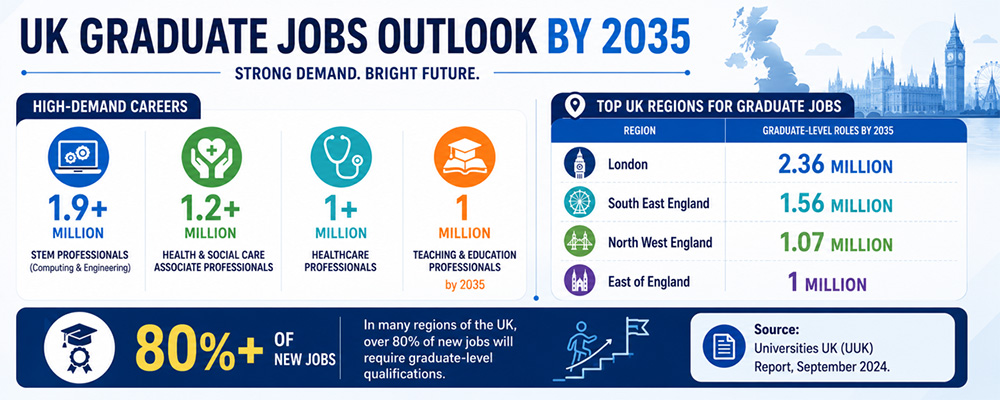
One of the biggest advantages for international students is the Graduate Route visa, which allows eligible graduates to stay in the UK after completing their studies to work or look for work. This gives graduates valuable time to gain UK work experience, build professional networks and secure graduate-level employment.
UK universities also invest heavily in students' career success through dedicated career services, CV and interview preparation, internships, placement opportunities, employer networking events and recruitment fairs, helping students become more competitive in the job market.
Ultimately, your career outcomes will depend on factors such as your course, skills, work experience, academic performance and career preparation. Students who actively engage with university career support, build relevant experience and start networking early are often well positioned to take advantage of the UK's growing graduate job market.
What are the entrance exams for study in UK for international students?
Observation: this should be written with a few paragraphs and then supported by an infographic.
This is a great question and interpreting the most recent official guidance will certainly help clarify this situation. First, the most important point to remember is UK systems are more flexible than US systems. For the great majority of undergraduate and postgraduate courses, there isn’t a single standardized entrance examination akin to the SAT or GRE.
In general, you show your “entrance exam” in two primary ways: your previous educational achievements (current high school or university grades) and your demonstrated command of the English language.
Here is how it looks according to the UK government (Gov.uk) and the Universities:
Academic Entry Requirements (The Main “Exam”)
In approximately 95% of courses, your current qualifications serve as your entrance exam. Universities determine whether the grades you have achieved are the equivalent of the required UK A-Levels (for Undergraduate) or a UK Bachelor’s degree (for Postgraduate). In most cases, you are not required to take additional tests, unless you are applying to a specific Highly Competitive Course.
Undergraduate (Bachelor’s): Universities recognize a multitude of international qualifications, such as the IB (International Baccalaureate), Indian Standard XII, US High School Diploma (generally with APs), or foundation year courses. You present these grades in UCAS.
Postgraduate (Master’s): You are required to have a Bachelor’s degree with the necessary classification (generally a 2:1 or 2:2 equivalent) from your home country.
English Language Requirement (Applies to All)
If your native language is not English and if your previous education was not conducted in English, you will need to show some evidence of your English skills to satisfy the UK Visa and Immigration (UKVI) and the university's English requirement.
The following tests are the most common (and are accepted if taken in the last two years):
- TOEFL iBT: This test is also widely accepted but some universities no longer accept it due to previous visa issues. Be sure to check the university's English requirements.
- PTE Academic: This is an increasingly popular test and is accepted by most UK universities.
- Cambridge C1 Advanced (formerly CAE) / C2 Proficiency: These tests are also accepted by many top universities.
- IELTS Academic: This is the most widely accepted test. Most universities in the UK require a minimum score of 6.5 to 7.0 at postgraduate level and between 6.0 and 6.5 at undergraduate level.
Important Visa Information:
It is essential to check if the university is a "Higher Education Provider" with a "Track Record". If they are, your student visa can be sponsored by the university based on their own internal assessment of your English through their own university tests or your TOEFL/PTE/IELTS scores. If the university is not on this list (usually lower tiered colleges), you will be required to take the "IELTS for UKVI", a test authorized by the Home Office.
Do not make educated guesses about which qualifications and English tests are accepted. We strongly advise you to reach out to expert study abroad counselors and get their professional guidance.
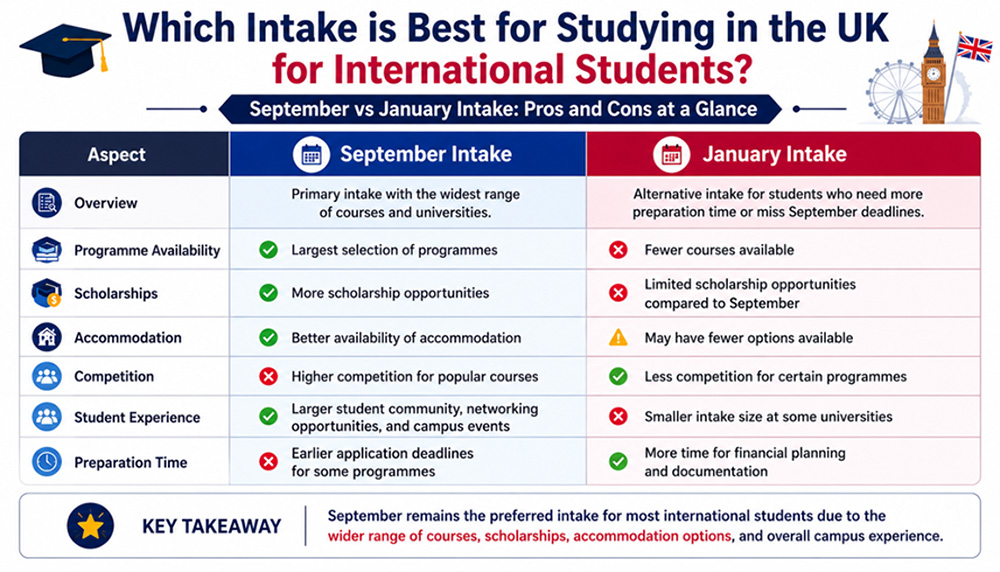
Which intake is best for studying in the UK for international students? What are the pros and cons of the January and September intake?
Most international students think the best option is the September (Fall) intake since it matches the traditional academic calendar. However, the January (Winter) intake is also an option if you think you will be more prepared then.
September Intake:
Pros: There will be a higher course selection, a larger pool of scholarships, the full campus experience, corporate graduate internships, and a full orientation.
Cons
- There is more competition, and accommodation crunch, hence applicants will have to submit applications early. The peak Summer student visa processing will take more time.
- More competition in part-time jobs
- Job market becomes more competitive
January Intake:
Pros: There is less competition, more time to prepare for the academic documents and tests, smaller classes and more time with the instructor, and faster visa processing.
Cons: There will be fewer classes to choose from which may limit your area of study to Postgraduate, IT, Business, etc. There will also be fewer scholarships and funding options, and it may be more difficult to align with corporate hiring.
How much money does an international student need in the UK?
Calculating how much money you need to bring to the UK as an international student is a little tricky because it depends on so many factors like your course and where you decide to live. Here we will try to break down the numbers needed to apply for a visa and your expected expenses.
Let’s have some numbers to get you started... (What you need for a visa).
To apply for a UK student visa, the UK Home Office requires you to cover the remaining first-year tuition (in addition to some monthly maintenance fees for up to 9 months). For the year 2026, the numbers will be as follows:
For students living in London, you will need £13,761 (that is £1,529/month). For those living outside of London, you will need £10,539 (that is £1,171/month).
A big factor to note is the 28 Day Rule, the exception being the loan letter. This means that all of that money needs to be in your bank account (the outstanding tuition and living expenses) for at least 28 consecutive days before you apply for the visa.
Applicants can apply for the visa immediately with a loan letter from a UKVI approved bank.
What to expect in the real world (or the 'reality check'):
The legally set baseline covers the bare minimum. The British Council along with students currently studying in the UK claims that the daily living expenses are much higher. This will vary with your living situation and personal lifestyle.
Living in London: Monthly expenses are typically around £1300 - £1400+. The cost of living, rent, and transportation (even with student discounts) takes a significant part of your budget.
Living in the rest of the UK: Monthly expenses are typically around £900 to £1300. You will be on the lower end of this range if you are studying in cities like Manchester and Sheffield.
These numbers include student housing, groceries, utility bills, Wi-Fi, transportation, and a little for your weekend outings.
Tuition Fees: the elephant in the room!
Your tuition is the highlight of the show. Out of living costs, tuition is the most variable. Course fee in a modern university in and around London may starts from £13,000 a year while a competitive STEM or MBA program in a top-tier university may cost you £30,000-£40,000.
There are low-cost MBA programs offered by modern universities.
The Bottom Line: Over budgeting is the goal, rather than the opposite. It is better to have too much than too little.
This is where our experienced UK experts can guide you through all the financial scenarios, so that you can make an informed decision.
What are the UK university scholarships available for international students?
There are several scholarships available to international students from the UK Government, UK universities and other groups. Depending on the scholarship, assistance may be in the form of full or partial tuition costs, living expenses or both.
Some of the most well-known scholarships are:
- Chevening Scholarships - UK Government-funded scholarships for exceptional students studying a 1 year master’s degree. The award covers tuition fees, living costs and other allowances.
- Commonwealth Scholarships - these are funded by the UK Government and are for eligible students from Commonwealth countries who are studying for a master’s or PhD.
- GREAT Scholarships - These awards, supported by the UK Government and partner universities, provide at least £10,000 towards tuition fees for suitable postgraduate courses.
- University Scholarships - Merit, subject or need-based scholarships are offered by several UK universities for international students. Examples are Vice-Chancellor’s and International Excellence Scholarships.
*Very competitive and high eligibility criteria
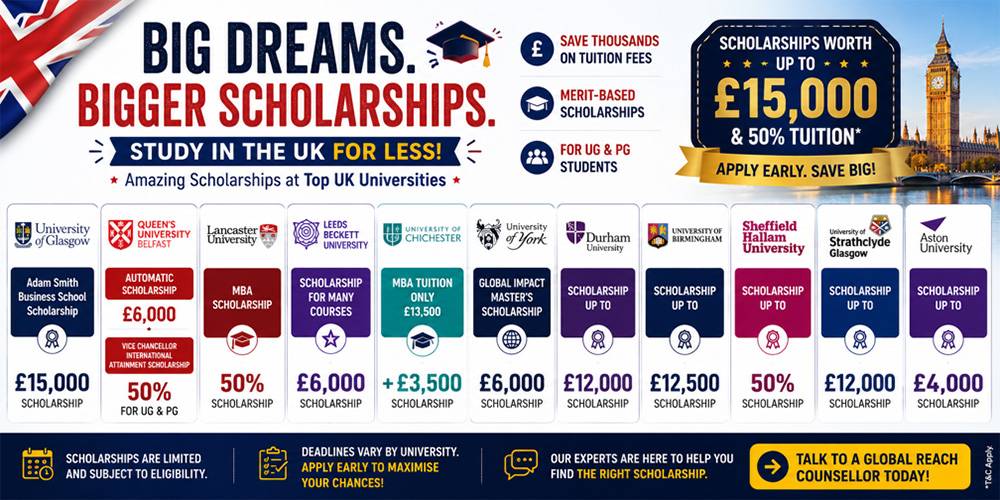
Some scholarships accept eligible individuals who apply for admission automatically, while others require an additional application. As funding is limited and deadlines are usually many months ahead of courses starting, it is advisable to investigate and apply as early as possible.
Can I afford to study in the UK as an international student?
Yes, but affordability depends on your choice of university, course, location, and personal lifestyle. Careful financial planning is essential before starting your studies.
The total cost of studying in the UK typically includes:
- Tuition fees (set individually by each university and course)
- Accommodation
- Food and groceries
- Local transport
- Study materials
- Personal expenses
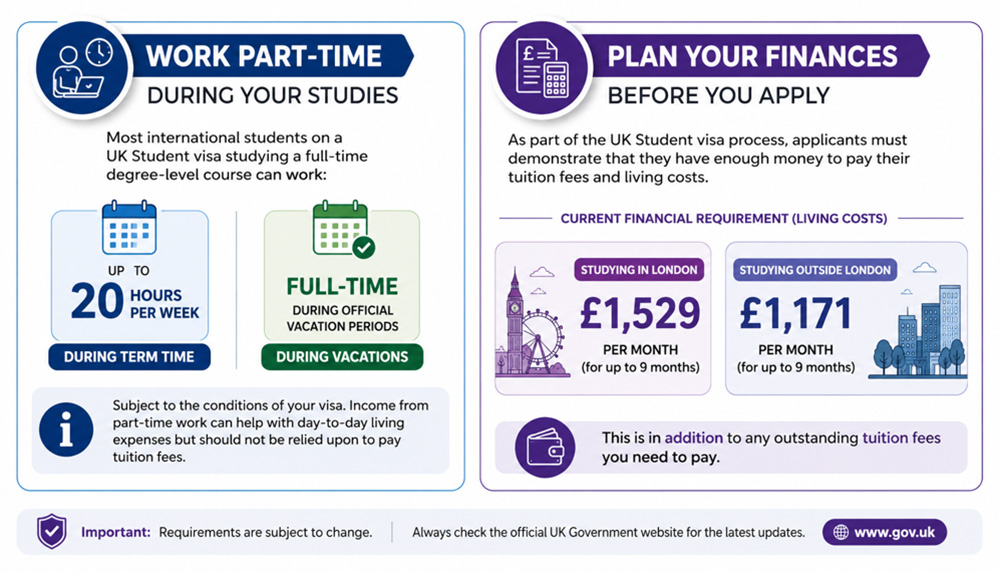
There are several ways to make studying in the UK more affordable
- Many UK universities offer scholarships, bursaries, and tuition fee discounts for international students. The availability and eligibility criteria vary by institution.
- Tuition fees differ between universities and courses. Living costs also vary across the UK, with London generally being more expensive than many other cities and towns.
- Depending on your home country, you may be eligible for education loans, government funding schemes, employer sponsorships, or other financial assistance to support your studies.
- Creating a realistic budget for accommodation, food, transport, study materials, and personal expenses can help you manage your finances effectively throughout your course.
With informed planning, the right choice of university, and available financial support such as scholarships and part-time work, many international students successfully fund their education and living expenses while studying in the UK.
Get expert guidance
on courses, costs, scholarships, and career opportunities
Can I get PR after studying in the UK?
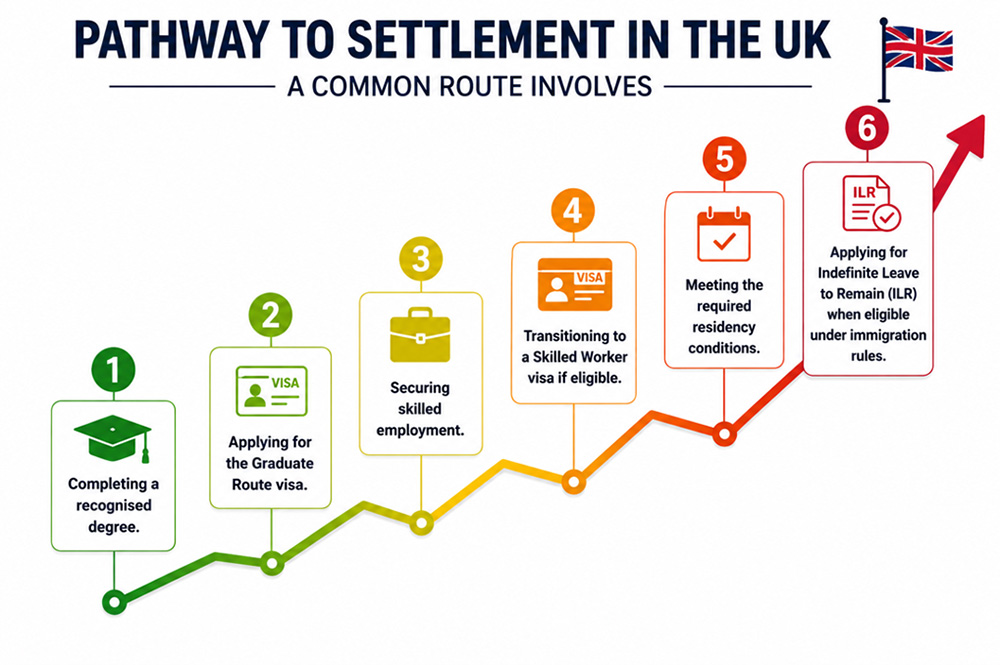
Studying in the UK does not automatically lead to Permanent Residency (PR), known as Indefinite Leave to Remain (ILR). However, it can be the first step towards building a long-term career and, eventually, becoming eligible to settle in the UK.
After completing an eligible degree, many international students choose to stay in the UK through the Graduate Route. This visa allows graduates to work, look for work, or gain professional experience for up to 2 years, or 3 years for PhD graduates, without needing employer sponsorship.
If you later secure a job with a UK employer that is licensed to sponsor overseas workers, you may be able to switch to a Skilled Worker visa, provided you meet the relevant eligibility requirements. Time spent on a Skilled Worker visa can count towards eligibility for Indefinite Leave to Remain (ILR). In most cases, applicants can apply for ILR after five years on an eligible visa route, subject to meeting the UK's immigration requirements.
Note: Time spent on the Graduate Route does not currently count towards the five-year qualifying period for ILR.
UK immigration rules are reviewed and updated from time to time. If your goal is to settle in the UK after graduation, it's a good idea to stay informed through official UK Government guidance and seek professional immigration advice before making long-term plans.
*Immigration policies can change over time, so students should always refer to the latest UK government guidance when planning for the future.
Is it difficult to get a UK student visa?
Whether it's difficult to get a UK Student visa depends on whether you meet the eligibility requirements set by UK Visas and Immigration (UKVI) and submit a complete application.
To apply for a UK Student visa, you must generally:
- Have an unconditional offer from a UK institution that is licensed to sponsor international students.
- Receive a Confirmation of Acceptance for Studies (CAS) from your university.
- Demonstrate that you have enough money to pay your tuition fees and living expenses. For living costs, applicants currently need to show £1,529 per month (up to 9 months) for courses in London or £1,171 per month (up to 9 months) for courses outside London, in addition to any outstanding tuition fees.
- Meet the English language requirement for your course, where applicable.
- Hold a valid passport or other accepted travel document.
- Provide any additional documents requested by UKVI, such as a tuberculosis (TB) test certificate if required for your country of residence.
To obtain UK students visa, a student has to qualify 70 points. On receiving CAS 50 points and on meeting financial requirements 10 points and on meeting English Language requirement 10 points.
Most visa refusals are linked to issues such as incomplete applications, incorrect or insufficient financial evidence, missing supporting documents, or failure to meet the eligibility requirements. Checking your documents carefully, applying early, and following your university's guidance can help reduce the risk of delays.
Many UK universities also have dedicated international student support teams that help applicants understand the visa process and prepare the required documentation before submission.
Will I get a job after graduation in the UK?
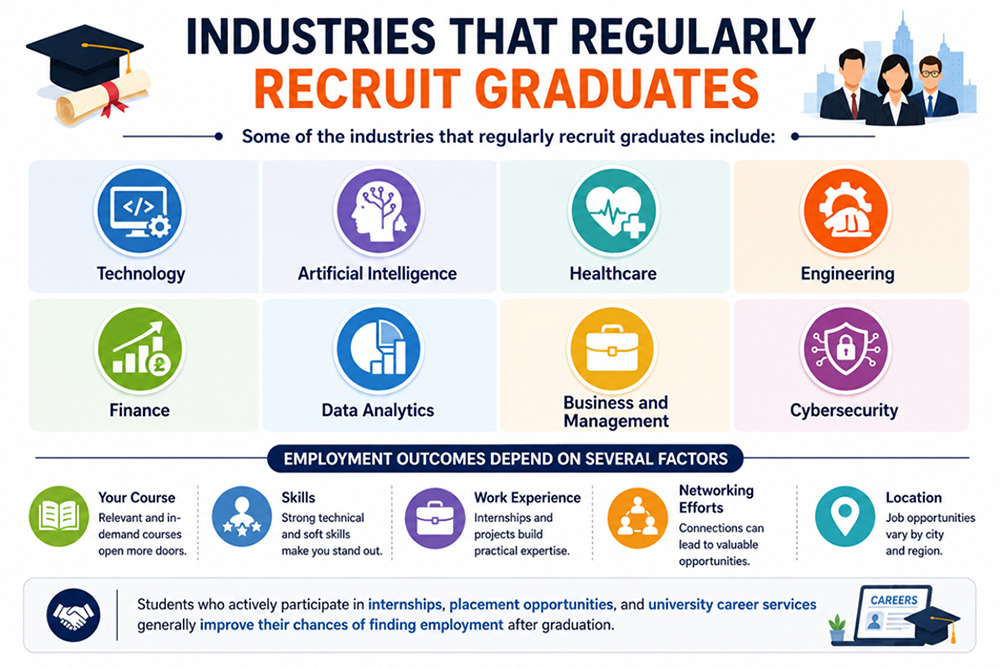
The Graduate Route visa provides additional support for eligible graduates who have completed their studies to get work experience after they finish studying in the UK.
What are the biggest mistakes students make before moving to the UK?
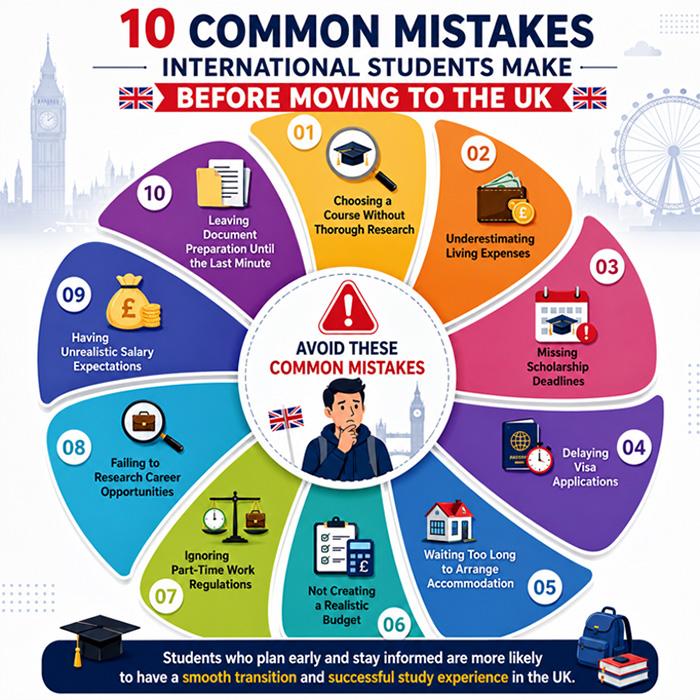
Relocating to the UK is an exciting step, but with the right preparation your transition can be a lot smoother. Many of the issues international students confront can be avoided by planning beforehand.
Some of the most common mistakes are:
- Putting everything off to the last minute. Waiting to apply for your visa, or to book your accommodation or organise your travel can reduce your options and add to your costs.
- Underestimating cost of living . You will also have to pay for lodging, food, transport, mobile bills, study materials and other day-to-day expenses on top of tuition fees.
- Selecting a university only on rankings. “Equally, the course content, graduate outcomes, location, tuition fees and local cost of living are important considerations.
- Not arranging lodgings early. Student accommodation may be very popular and fill up very fast, especially before major intakes.
- Not knowing the conditions of your Student visa. Before you travel, check the terms of your visa, including work rights, reporting obligations and the date your visa expires.
- Not paying attention to university communications. Universities give crucial details about enrolment, accommodation, orientation, and arrival, so check your email periodically.
- Packing without a plan. Please bring with you any important documents, any medicines you may need, adequate clothing for the UK climate and any other items recommended by your university.
By preparing early, staying organised and following guidance from your university and the UK Government you can help you settle into life in the UK with greater confidence from day one.
Connect with our experts for personalised guidance
Studying in the UK will give you so much more than just earning a college degree. It gives you access to internationally known universities, excellent job opportunities, exposure to other cultures, and a chance to develop personally.
To make the best decision about your education, you must look at the entire picture by considering tuition, scholarships, visas, costs of living, and job opportunities.
Whether you are still exploring your options or submitting your applications, you must gather information about studying in the UK before you begin your process for studying abroad successfully.