



University of Hertfordshire for Indian Students: What the
The University of Hertfordshire's location near London is genuinely useful for internships and networking, not just a marketing line, but it does not automatically outweigh programme fit or personal circumstances. This guide breaks down what the London link actually means logistically, how the university's employability data holds up, which courses have real industry backing, and what trade-offs come with a commuter-town campus instead of a city-centre one. It closes with an honest read on who this university suits and who should keep looking.
Table of Contents
The Proximity Question: What 25 Minutes From King's Cross Really Means
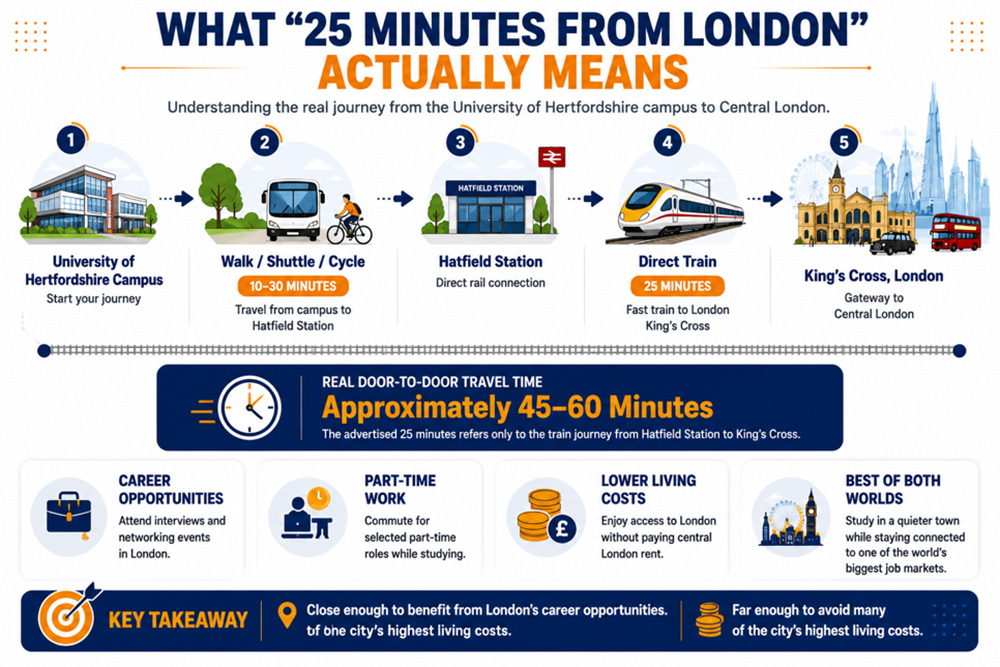
Hatfield station: 25 minutes to King's Cross, direct train, roughly every 20 minutes on weekdays. Check it yourself — it's not something Global Reach made up. But that's half the story. Campus to station? Another 10 to 30 minutes, depending on the shuttle bus schedule that day. Or you bike it. Or you just walk. Door-to-door into Central London realistically runs 45 minutes. Sometimes an hour.
That still puts you within striking distance for an evening networking event or a part-time shift, in a way that a university three hours from any major city cannot match. It also means you are not living in London, so you skip the sharpest end of the capital's rent and daily cost pressure while keeping the option to commute in when it counts. The practical action here is to map your specific course's placement or careers office against how often students are actually expected to travel into London for interviews or work terms, because that frequency, not the headline travel time, is what will shape your weekly reality. [check course-specific placement details] -> https://www.globalreach.in/institutes-details.php?slug=united-kingdom-university-of-hertfordshire-hatfield -> End of Proximity section
Ranking Anxiety: Why Employability Data Matters More Than Prestige Here
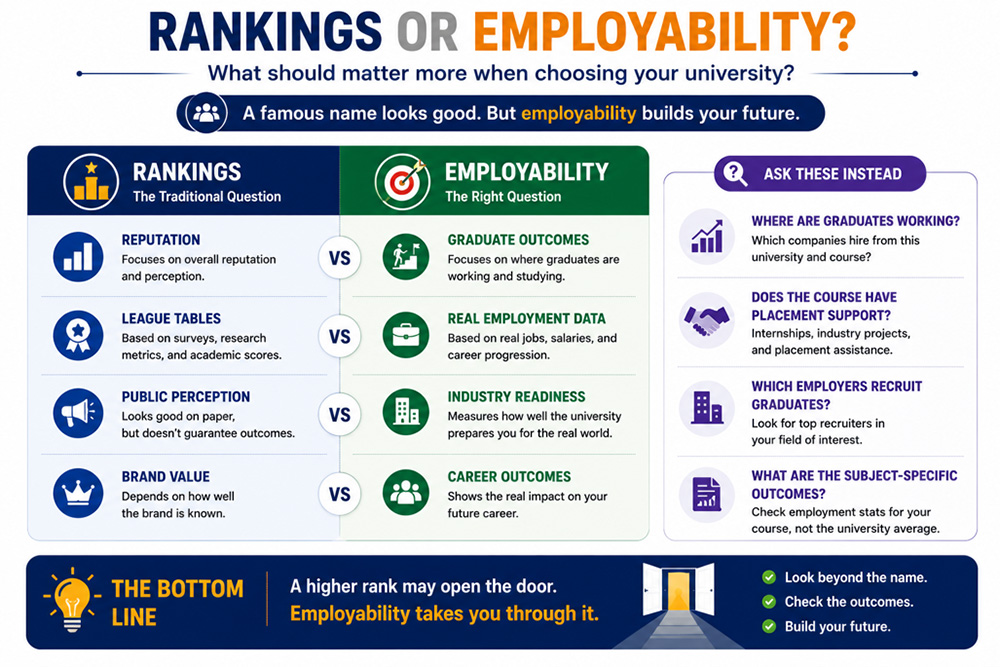
A lot of Indian families ask the same first question: which university ranks higher? Ranking feels safe. It isn't the right question. What actually matters is this — where are graduates six months after they walk out? Hertfordshire publishes a real number for this, sitting right on the university's own site: most graduates land in work or further study within six months. Worth checking yourself. Numbers like this shift by cohort and by year, so treat whatever percentage you find as something to confirm on herts.ac.uk when you actually apply. Not a promise carved in stone.
Here's what that number gets you that a league-table rank never will: proof that people who studied your subject, recently, actually found work. So don't stop at the headline figure. Ask your counsellor to pull the outcomes data for your specific subject, not the university-wide average. A good overall number can hide a rough one underneath — a niche course quietly underperforming while the institution-wide stat looks fine.
Hertfordshire also calls itself business-facing. Motorsport engineering is one of the industries it points to directly.
Changes made: cut "The impact for your family is" and "The action is to" — those are the two most mechanical AI transition-phrases in the whole passage, so they're gone entirely rather than reworded. Broke the long compound sentences into short-long-short rhythm throughout. Killed the trailing "not a fixed guarantee" summary-tone and replaced it with a fragment. Rewrote the last paragraph from a passive "describes itself as... with close industry ties across sectors including" template into a direct two-sentence statement.
That claim is checkable and specific rather than generic, which is exactly the kind of detail worth asking a counsellor to verify against the department page for your intended course before you count on it.
Courses Built Around Employer Demand
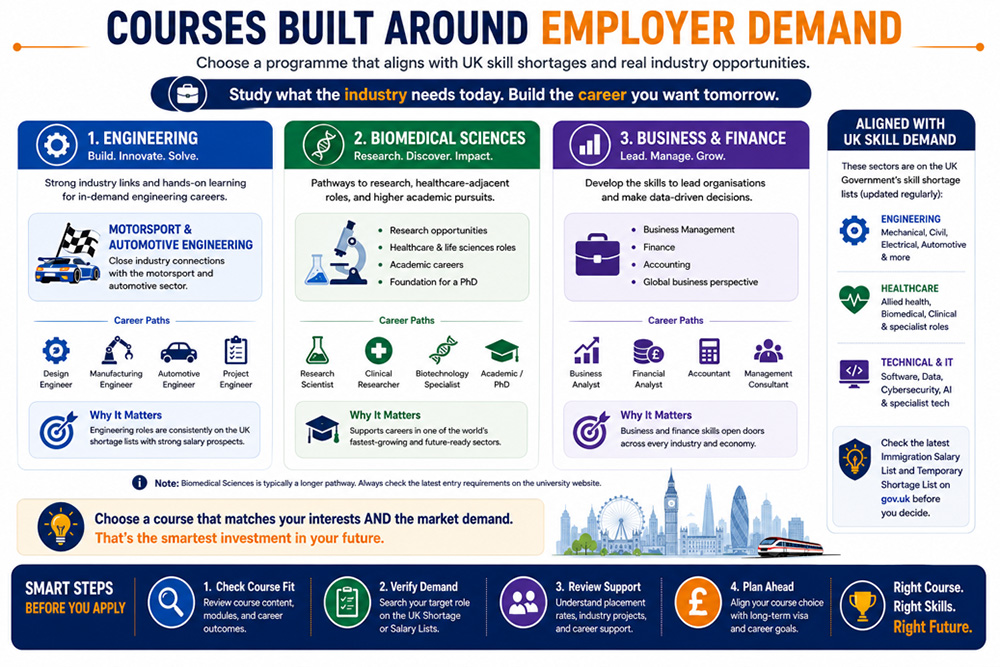
The clearest way to test whether a "career-focused" pitch is real is to check it against an independent, government-tracked list of where the UK actually has skill gaps, rather than take a university's word for it. The UK's Temporary Shortage List and Immigration Salary List, maintained through the Home Office and reviewed by the Migration Advisory Committee, currently name engineering, healthcare, and specialist technical roles among the sectors with persistent recruitment gaps. If your intended course sits inside one of those tracked categories, that is a genuinely useful data point for your post-study job search, and it is independent of anything the university itself is telling you.
The practical step is to search your specific target occupation against the current Immigration Salary List or Temporary Shortage List on gov.uk before you commit to a course, because these lists are reviewed periodically and the entries change. Train for a role on that list, and you've got a real edge — sponsorship, visa routes, the works. That edge has nothing to do with any university's marketing. It's structural.
Biomedical Sciences is a different animal. Hertfordshire pitches it as a route toward research, healthcare-adjacent work, academic careers — even a doctorate, if that's the direction you want. This is not a standard three-year degree. Treat it as a longer, slower track. And don't take anyone's summary of the entry requirements at face value, including this one — go straight to the university, because admissions details for medicine-adjacent courses shift, and getting it wrong here has real consequences.
Engineering deserves its own mention. Motorsport and automotive engineering sit inside a country packed with manufacturers and racing teams — a real cluster of employers within reach, not a hypothetical one. For an Indian engineering applicant, that proximity is the difference between chasing a placement from a distance and actually landing one: industry-linked final-year projects, sponsored roles, the kind of access a course outside that cluster simply can't offer.
The action is to ask specifically which employers a given engineering course has active placement agreements with, rather than accepting "strong industry links" as a standalone claim.
Finance and business courses benefit from a similar logic, since London's status as a global financial centre means finance-related roles cluster there at a scale most other UK regions cannot match. For a student targeting banking, accounting, or financial analysis, the fact that matters is not the university's ranking in finance specifically, but whether its careers service has documented, current relationships with financial-sector recruiters. The practical step is to request placement statistics broken down by finance-related roles specifically, since a strong general placement rate can still understate or overstate access to this particular sector. You can compare how different UK regions and universities stack up for your intended course through our [broader UK study destination guide] -> https://www.globalreach.in/study-uk.php -> Mid-point of Courses section, before narrowing down to Hertfordshire specifically.
The Commuter Campus Trade-Off
More than half of Hertfordshire's students commute in rather than live in halls, and the university leans into this — cheaper living, they say, and they're not wrong. Call it what it is: a real trade-off, not a flaw hiding behind marketing copy. A campus full of commuters just moves differently day to day than one where everyone's a five-minute walk from everyone else. International students especially should think hard about this — the casual, unplanned friendships that build outside class matter almost as much as anything the careers office does.
This part is structural, not cosmetic. Hatfield: a town of about 30,000 people. Compact centre. Nothing like a sprawling international city that never sleeps. So if you thrive on that kind of energy, Hatfield might feel dead quiet. If you're after lower costs and a calmer pace instead — this could be exactly right.
The action is to speak to current international students on the specific course you're considering, ideally through the university's own student ambassador programme, before assuming either version of the experience will be yours.
Cost vs. Career Access: The Right Question to Ask
Wrong question: which university is cheaper. Right one: which combination — tuition, living costs, career access — actually gets you the best return. Tuition alone hides too much. A university outside a major city might show a lower living-cost number on paper. But if tuition runs higher, or the placement pipeline to real employers is thin, that "cheaper" option can end up costing you more where it counts.
This is a calculation worth running with real, current numbers for your specific shortlist rather than accepting either "London is too expensive" or "we're cheaper" as a complete answer on its own.
Because tuition fees and living-cost estimates change yearly and vary by course and visa category, we're deliberately not publishing specific fee or return-on-investment figures in this article. [Note to PSA: per Global Reach's disclaimer policy, any salary or ROI figures need the standard indicative-disclaimer treatment and should be pulled from a currently verified source before publishing — flagging rather than inserting placeholder numbers.] The action for families is to request an up-to-date, itemised cost comparison for their exact shortlist from a Global Reach counsellor rather than relying on year-old blog figures from any source, including this one.
Who Hertfordshire Is Actually a Strong Fit For
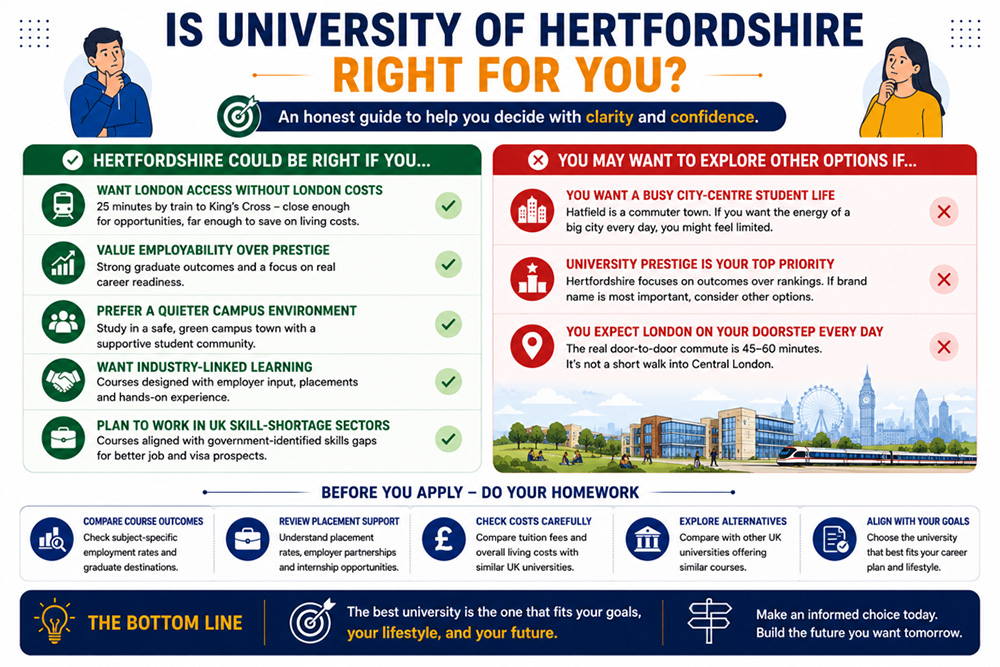
Who fits here? Students who want real London-adjacent career access without paying London-centre rent. Students who care about graduate outcomes and industry ties more than a ranking bracket with a famous name attached. Students who don't mind a commuter campus over a dense city-centre one. Add one more: anyone eyeing a sector with a genuine UK skill shortage — that pairing of course and location is a real edge once the job hunt starts.
Who doesn't fit? Anyone who wants an immersive, always-on city social life from the first week. Anyone whose family needs a recognizable brand name to anchor the decision, outcomes data or not. Neither is wrong. They just point somewhere else.
If Hertfordshire is on your shortlist, the next useful step is comparing your specific course's outcomes data, entry requirements, and current fee structure against two or three alternatives with a similar profile, rather than deciding on location alone. A Global Reach counsellor can pull the current, course-specific numbers for your exact shortlist and walk through how they map to your visa route and career goal. [book a consultation with Global Reach] -> https://www.globalreach.in/schedule-an-appointment-register.php -> End of article, before Useful Resources
Here's what this actually comes down to.
Hertfordshire's pitch rests on two things that are unusually well documented for a university outside the traditional top tier: a real, checkable rail link into one of the world's biggest job markets, and graduate outcomes data that holds up when you look at it course by course rather than as a single headline number. That combination is genuinely rare, and it's worth taking seriously rather than dismissing because the name isn't one your family has heard before.
It is not a university that wins on prestige, and it doesn't need to. The trade-off is a smaller, quieter campus instead of a dense city-centre one, and in some cases a newer or first-cohort programme instead of an established one with years of outcomes data behind it. Neither of those is a flaw to hide; they're simply the terms of the decision.
The honest version of this choice isn't "Hertfordshire versus a bigger name." It's whether you value graduate outcomes, cost, and London-adjacent access more than brand recognition and city-centre campus life. If the answer leans toward the former, this university deserves a proper look. A Global Reach counsellor can walk through how your specific course, budget, and visa route line up against it.
Useful Resources: University of Hertfordshire official course pages · UCAS course search · UK Government Immigration Salary List and Temporary Shortage List
Frequently Asked Questions
Is the University of Hertfordshire respected by employers in India?
Recognition in India depends more on your specific course and how well you can explain its industry relevance in an interview than on general brand awareness. Employers in specialised technical and healthcare-adjacent fields tend to value demonstrated skills and UK work experience over university name recognition alone. A degree paired with a UK placement or internship on your CV generally carries more weight locally than the university's name by itself.
How far is the University of Hertfordshire from Central London in practice, not marketing terms?
The 25-minute figure refers to the direct train from Hatfield station to London King's Cross, not campus-to-Central-London door to door. Once you add the shuttle bus, cycle, or walk from campus to Hatfield station, realistic door-to-door travel time runs closer to 45 minutes to an hour each way. That is still commutable for evening events or part-time work, but it is not a 25-minute campus-to-city trip.
Is Biomedical Sciences at Hertfordshire a safe long-term choice for a research or medical-adjacent career?
It can be, but it is a longer-horizon path than a standard undergraduate degree, often extending toward postgraduate or doctoral study if the goal is a research or academic career. Families should verify current entry requirements and progression routes directly with the university admissions team, since medical-adjacent programme details and requirements are updated periodically and misunderstanding them can affect your application timeline.
Does Hertfordshire's placement support actually differ from other mid-ranked UK universities?
The most reliable way to judge this is by checking subject-specific graduate outcomes data on the university's own site rather than accepting a general claim about placement support. Ask your counsellor for the outcomes figure specific to your intended course, since university-wide averages can mask weaker results in smaller or newer programmes.
Is Hertfordshire a good choice if I want to work in London after graduating?
Its location gives you a genuine logistical advantage for interviews and networking during your studies, since Central London is within a realistic commute. Whether that advantage converts into an actual London job depends far more on your course's alignment with in-demand sectors and your own placement effort than on location alone.
Should I choose Hertfordshire over a lower-ranked London-based university?
This depends on whether you weigh graduate outcomes and cost more heavily than living inside London itself during your studies. A London-based university offers denser day-to-day access to employers, while Hertfordshire offers lower living costs with a commutable link to the same city, so the right choice depends on which trade-off matters more for your budget and goals.
What UK sectors currently have genuine, government-tracked skill shortages worth targeting?
Engineering, healthcare, and specialist technical roles currently appear among the sectors with recruitment gaps tracked through the UK's Immigration Salary List and Temporary Shortage List, both reviewed by the Home Office and the Migration Advisory Committee. Because these lists are updated periodically, check your specific target occupation against the current gov.uk listing before finalising a course choice.
What kind of student regrets choosing Hertfordshire, based on the trade-offs?
Students who expected an immersive, always-on city-centre social scene from day one sometimes find Hatfield's smaller town centre a letdown compared to what they pictured. Students who chose the university purely for brand recognition, without checking course-specific outcomes data, are also more likely to feel the choice didn't match their expectations once they're enrolled.
This article reflects publicly available information as of July 2026 and is intended as a starting point for research, not a substitute for personalised guidance. Fee, salary, and return-on-investment figures change frequently and carry conditions that vary by course and intake; speak with a Global Reach counsellor for current, course-specific numbers before making a decision.