



Education Loan for Study Abroad without Collateral
Studying abroad can involve a significant financial investment, but owning property is not always a requirement for securing an education loan.
Students may be eligible for collateral-free education loans under government-backed frameworks or specific bank schemes. Under the Credit Guarantee Fund Scheme for Education Loans (CGFSEL), eligible education loans up to ?7.5 lakh can be covered without collateral security and third-party guarantee.
For higher loan amounts, some banks offer collateral-free education loans for students admitted to selected premier overseas institutions. For example, SBI's Global Ed-Vantage scheme currently offers collateral-free loans of up to ?50 lakh for select institutions.
The amount you can borrow without collateral depends on the university, course, destination, loan amount, lender and your eligibility.
Can you get an education loan for Study Abroad without collateral?
Yes, in certain cases.
An education loan without collateral means that you do not have to pledge property, fixed deposits or another acceptable asset as security for the loan.
However, collateral-free does not mean that every student can borrow any amount without security.
The loan amount and eligibility depend on the lender's rules, the university and course you have been admitted to, your financial profile and the specific education-loan scheme.
For example, SBI's Global Ed-Vantage scheme is designed for students pursuing full-time regular courses at foreign universities. It currently offers loans above ?7.5 lakh and up to ?3 crore, with collateral-free loans of up to ?50 lakh available for select premier institutions.
This is why students should check their university and course eligibility before assuming that a large overseas education loan will be available without collateral.
What is a collateral-free Education Loan?
Collateral is an asset that a borrower pledges to the lender as security against a loan.
For education loans, this may include:
- Property
- Fixed deposits
- Government securities
- Insurance policies
- Bonds
- Other assets accepted by the lender
A collateral-free education loan does not require such an asset to be pledged under the applicable loan scheme.
But there is an important distinction
Collateral-free does not necessarily mean co-applicant-free.
A bank may still require a parent, guardian or spouse to be a co-borrower.
For example, SBI's Global Ed-Vantage scheme requires the co-obligation of parents or guardians for its collateral-free facility.
How much can you borrow without collateral?
There is no single collateral-free loan amount that applies to every student.
Up to ?7.5 lakh
Under the Credit Guarantee Fund Scheme for Education Loans, eligible education loans up to ?7.5 lakh can be covered without collateral security and third-party guarantee.
This provides an important route for students whose funding requirement falls within the applicable limit.
More than ?7.5 lakh
For a larger loan, eligibility depends on the bank and the university.
Some lenders have separate schemes for students admitted to select premier institutions.
For example, SBI currently lists:
- Loans above ?7.5 lakh up to ?3 crore under Global Ed-Vantage
- Collateral-free loans up to ?50 lakh for select premier institutions
- Repayment through EMI for up to 15 years after the applicable moratorium period
Union Bank of India also has a special abroad-study education loan scheme under which eligible students admitted to its specified Category A premier institutions can access loans of up to ?40 lakh without collateral security or third-party guarantee.
These examples show why the university you choose can directly affect your education-loan options.
What are the options for higher loan amounts?
If your overseas education will cost ?20 lakh, ?30 lakh, ?40 lakh or more, you may still find a collateral-free option, but you need to check the lender's institution list and eligibility criteria.
Some banks have separate unsecured loan provisions for selected universities.
This makes the order of planning important
University → Course → Total Cost → Funding Requirement → Education Loan Options
Instead of deciding on a loan first, start by understanding how much your chosen programme will actually cost.
Calculate the total cost of study
Your funding requirement may include
- Tuition fees
- Accommodation
- Food and living expenses
- Health insurance
- Travel
- Visa-related costs
- Books and study materials
- Other university or course-related expenses
For example, SBI's Global Ed-Vantage scheme lists tuition, hostel, examination, library and laboratory fees, travel expenses and certain study-related equipment among eligible expenses.
The expenses covered and the amount approved for each category depend on the lender.
Is a Co-Applicant Required?
In many cases, yes.
A collateral-free loan may still require a parent, guardian or spouse to be associated with the loan.
The lender may assess the co-applicant's:
- Income
- Existing financial commitments
- Credit history
- Employment or business details
- Age
- Relationship with the student
For example, SBI's Global Ed-Vantage terms specify parents or guardians as co-obligators for the collateral-free facility. Union Bank's specified premier-institution abroad scheme requires either a parent or spouse as co-applicant/guarantor.
So, when comparing education loans, ask two separate questions:
Is collateral required?
Is a co-applicant required?
The answer to one does not automatically answer the other.
What expenses can an Education Loan cover?
Depending on the lender and loan scheme, an Overseas Education loan may cover expenses such as:
- Tuition fees
- Examination and university fees
- Hostel or accommodation expenses
- Travel expenses
- Books and study materials
- Computers or other required equipment
- Laboratory and library charges
- Other approved expenses related to the course
The exact list varies by lender.
Some banks may also set limits on certain expenses, so students should understand the approved expense categories before finalising the loan.
What affects education Loan Approval?
Getting an offer from a foreign university is an important step, but it does not automatically guarantee an education loan.
The lender may consider several factors.
- University and course
- Loan amount
- Academic profile
- Co-applicant's financial profile
- Destination and programme
- Repayment capacity
This is why there is no universal rule such as
Admission abroad = guaranteed collateral-free loan
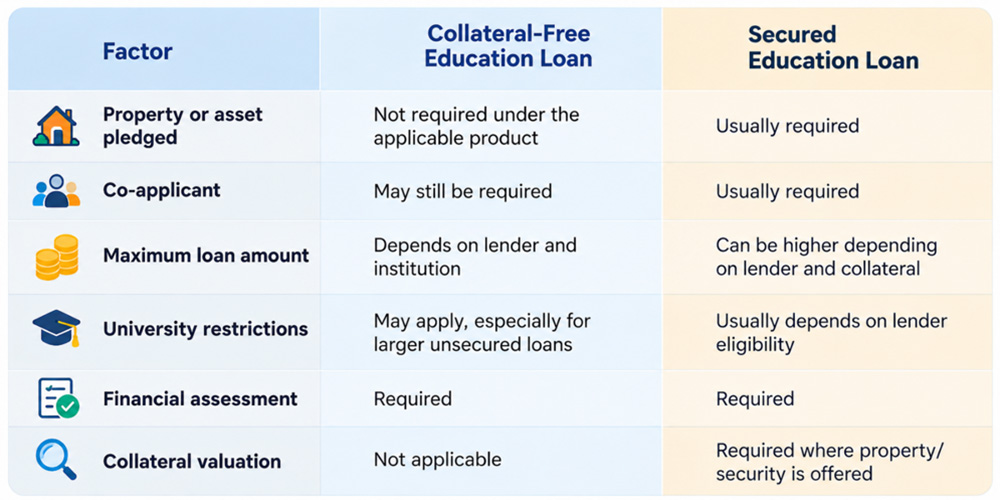
Neither option is automatically suitable for every student. The appropriate route depends on the total cost of study, the university, the amount required and the lender's terms.
Financing is an important part of planning to study abroad, and not having property to offer as collateral does not necessarily mean that an education loan is out of reach.
Eligible students may have access to collateral-free loans through government-backed frameworks or specific bank schemes. For example, CGFSEL provides for eligible education loans up to ?7.5 lakh without collateral security and third-party guarantee, while some banks offer higher unsecured amounts for students admitted to selected overseas institutions.
However, collateral-free education loans are not one-size-fits-all. Your university, course, loan requirement, co-applicant profile and lender's eligibility criteria can all affect the options available to you.
The best time to explore financing is before finalising your study abroad plans. Knowing your expected costs and funding options can help you make a more informed decision about your university and overall budget.
Planning to study abroad but unsure how to finance your education?
Global Reach can help you explore universities and courses, understand the overall cost of study, identify scholarship opportunities and understand the education-loan options you may need to consider.
Speak to Global Reach and start planning your study abroad journey with more clarity.
FAQs
Can I get an education loan for studying abroad without collateral?
Yes. Certain government-backed and bank-specific education-loan schemes allow eligible students to borrow without pledging property or other collateral. The amount and eligibility depend on the scheme and lender.
How much education loan can I get without collateral?
Under CGFSEL, eligible education loans up to ?7.5 lakh can be covered without collateral security and third-party guarantee. Some banks offer higher collateral-free limits for students admitted to selected institutions.
Can I get a ?20 lakh education loan without collateral?
It is possible in some cases, depending on the bank, university and loan scheme. Some lenders offer higher collateral-free loans for selected premier overseas institutions.
Can I get a ?30 lakh education loan without collateral?
This depends on the lender and your university. Higher-value unsecured loans are generally linked to specific institution lists and eligibility conditions.
What is the maximum collateral-free education loan for study abroad?
There is no single maximum applicable to every lender. Under CGFSEL, the applicable limit is ?7.5 lakh. Individual banks may offer higher collateral-free amounts for selected institutions. SBI currently lists up to ?50 lakh without collateral for select premier institutions under Global Ed-Vantage.
Is a co-applicant required for a collateral-free education loan?
A co-applicant may still be required even when no collateral is pledged. The exact requirement depends on the lender and loan product.
Can I get an education loan without property?
Yes. Certain education-loan products do not require property or another asset as collateral, subject to their eligibility conditions.
What documents are required for an overseas education loan?
Common documents include your admission letter, academic records, passport, university fee structure and identity documents, along with financial and income documents from the co-applicant. The lender may request additional documents.
Can an education loan cover living expenses abroad?
Some education-loan schemes allow approved living or accommodation expenses within the sanctioned loan. The amount and conditions depend on the lender and loan product.
Does a scholarship reduce the amount I need to borrow?
It can. A scholarship reduces your overall education cost, although the way it is treated in the loan calculation varies by lender.
Is collateral-free better than a secured education loan?
The two options have different requirements. A collateral-free loan avoids pledging an asset, while a secured loan may allow access to a larger amount depending on the lender and value of the collateral. Students should compare the total cost and terms of each option.