



Top 10 High-Demand Courses in the UK for Indian Students - What Actually Leads to a Job in 2027
The high-demand courses in the UK for Indian students worth shortlisting for 2026/27 aren't the ones trending on social media — they're the ones sitting inside the UK government's own eight priority growth sectors, with a realistic starting salary that clears the Skilled Worker sponsorship bar. Think AI and data science, cybersecurity, nursing with NMC registration, clean energy and advanced engineering, finance, and construction management. Not a popularity contest. Sponsorship math.
"My cousin says nobody's hiring in the UK right now."
Every week, some version of the same panic shows up. A parent forwards a screenshot with no context. A student's up scrolling Reddit at 1am. That's enough - the whole plan starts feeling shaky.
So start with what's true. Not what's trending.
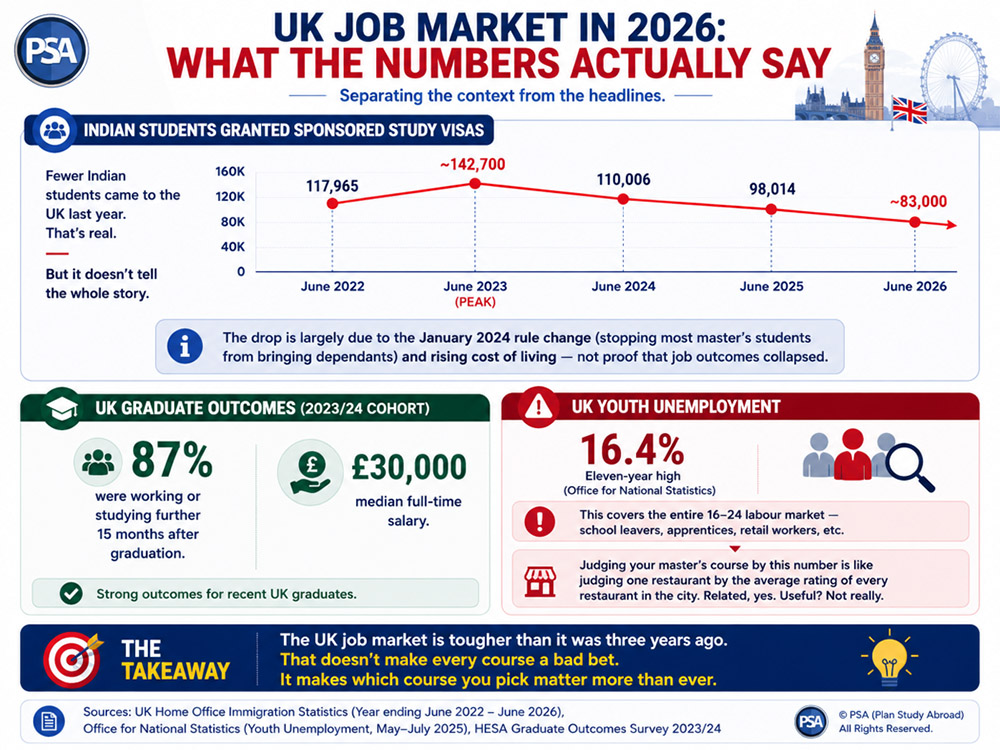
Fewer Indian students went to the UK last year. Down from the year before, and the year before that. Year ending June 2023 was the peak — roughly 142,700 Indian students granted sponsored study visas. By year ending June 2026, that number had dropped to about 83,000, per the Home Office's own immigration statistics.
That's a real drop of close to 40%.
| Year ending | Indian sponsored study visas granted |
|---|---|
| June 2022 | 117,965 |
| June 2023 (peak) | ~142,700 |
| June 2024 | 110,006 |
| June 2025 | 98,014 |
| March 2026 | 90,425 |
| June 2026 | ~83,000 |
Here's what that number doesn't tell you. Most of the drop traces back to a January 2024 rule that stopped most master's students from bringing dependants, plus the rising cost of living. It isn't proof that job outcomes collapsed.
Then there's the headline worrying people. UK youth unemployment, 16.4%. Eleven-year high, per the Office for National Statistics. That number's real too. Nobody's disputing it.
But that figure covers the entire UK youth labour market - school leavers, apprentices, retail workers, everyone aged 16 to 24.
Judging your master's course by that number is like judging one specific restaurant by the average rating of every restaurant in the city. Related, technically. Not actually useful.
Forget that headline for a second. Look at the 2023/24 graduate cohort instead — HESA tracked them 15 months after they finished. 87% were working or studying further. Just those two outcomes. The other number: median full-time salary landed at £30,000. Source is HESA's Graduate Outcomes survey, if you want to check it yourself.
The UK job market for Indians Student is genuinely tougher than it was three years ago. That doesn't make every course a bad bet. It makes which course you pick matter more than it used to.
The two filters that decide if a course is worth it
Every parent asks some version of the same question eventually: how do we know which course will work?
Two filters. Almost everything else is noise.
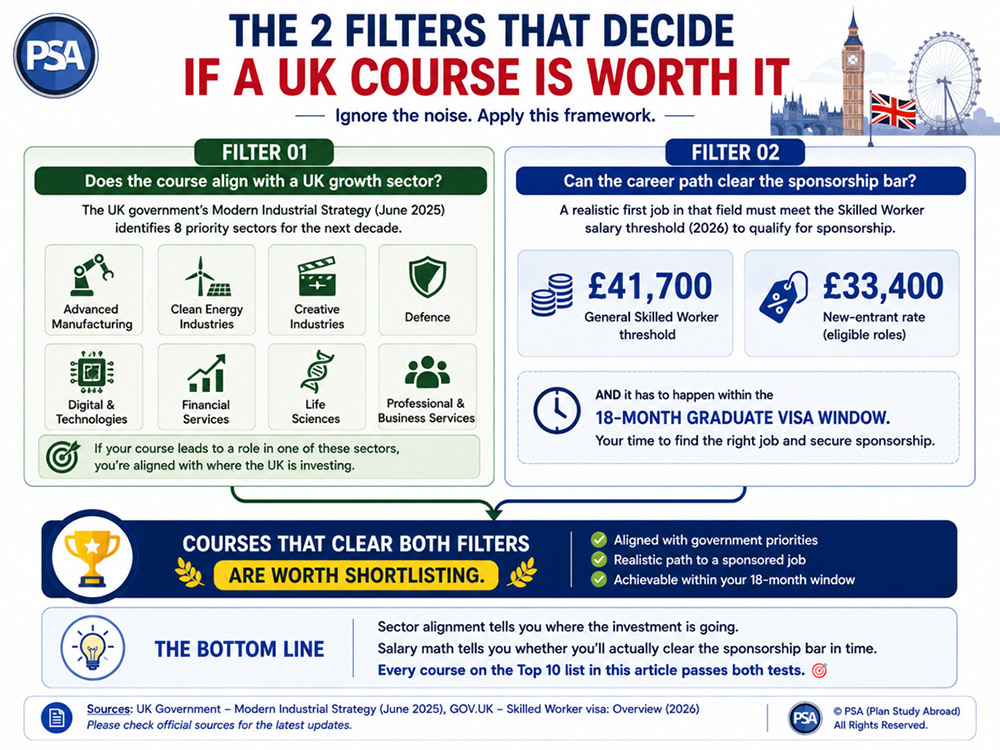
First question: does the occupation fall inside one of the eight sectors the UK government's committed to growing? June 2025 - that's when the Modern Industrial Strategy came out. Eight priority areas, named directly: Advanced Manufacturing, Clean Energy Industries, Creative Industries, Defence, Digital and Technologies, Financial Services, Life Sciences, Professional and Business Services. Next decade's focus, straight from, gov.uk.
That isn't branding language from a university prospectus. It's the government's own capital-allocation plan.
Second question: can a realistic first job in that field clear the Skilled Worker sponsorship bar? 2026 numbers - £41,700 a year, or £33,400 with the new-entrant discount, straight from gov.uk. And it has to happen inside that 18-month runway the Graduate visa gives now.
Think of it like buying a flat near a train line, right before a new station opens. Nobody's betting on the neighbourhood as it looks today. The bet's on where the moneys already headed.
Sector alignment tells you where the investment is going. Salary math tells you whether you'll clear the sponsorship bar in time. Every course on this list passes both tests.
The Top 10 high-demand courses in the UK for Indian students — and why each one clears the bar
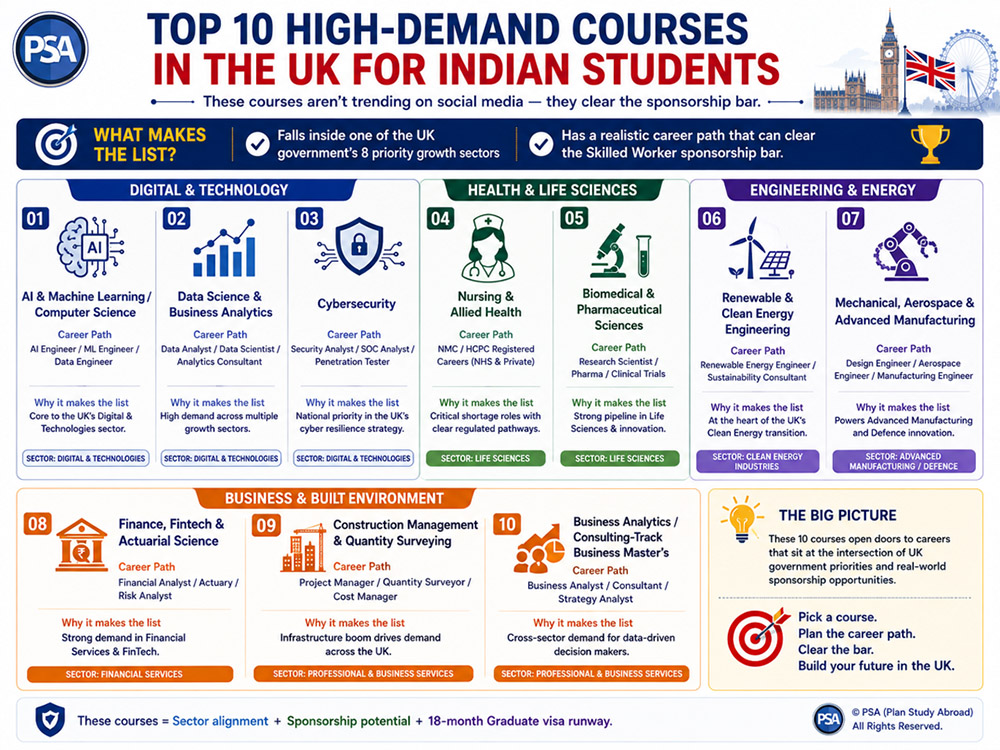
Eighty-one percent of Indian students who came to the UK these past three years - master's, not bachelors. That's from gov.uk's own visa data. Business used to be the default subject choice. Still is, traditionally. But British Council's research is picking up a clear shift now — toward STEM, and it's not slowing down. These ten sit at that intersection.
One honest note before the list: not every course here clears the £41,700 or £33,400 bar in year one. A few take an extra year or two, and that's a normal part of certain career paths, not a red flag specific to that course. Where that's the case below, we've said so plainly, along with what helps close the gap.
1. AI & Machine Learning / Computer Science:
Computing is currently the fastest-growing subject in UK higher education, and it sits squarely inside the government's Digital and Technologies growth sector. The degree usually covers machine learning, neural networks, computer vision, and natural language processing, and the strongest programmes build in a substantial industry project rather than treating it as an afterthought.
Entry-level roles include machine learning engineer, data engineer, and AI research assistant, and these routinely clear the £41,700 threshold on their own, without needing the new-entrant discount. Hiring isn't limited to tech firms either — banks, retailers, and the India-based global capability centres of multinational companies are all competing for the same graduates.
The real risk isn't the subject. It's choosing a course that's heavy on theory and light on cloud platforms, MLOps pipelines, and the applied project work employers actually screen for at interview. A strong project portfolio built during the degree often matters more to a hiring manager than the university's overall league table position.
Best suited for: a student who already has some hands-on coding experience, even self-taught, and is genuinely comfortable with maths-heavy content — this isn't the place to get a first exposure to programming.
2. Data Science & Business Analytics:
This sits at the overlap of Digital and Technologies and Financial Services, which means two hiring pipelines instead of one. Typical modules cover statistical modelling, SQL and Python, data visualisation, and increasingly, the applied generative AI tools now used in business reporting.
Graduates usually move into analyst or associate roles inside banks, consultancies, or retail analytics teams, and these comfortably clear the new-entrant salary floor within the first year, often crossing £41,700 by year two. Funny thing about this degree — it travels well. Every big company, whatever sector, runs some version of a data team now.
Look for programs with an actual industry placement. A live client project. Not some "capstone" a lecturer grades alone in an office. That one distinction shows up fast — in how confidently a graduate handles a real dataset, first week on the job.
Best suited for: A student who likes spotting patterns. Who can explain what a graph means to someone who's never touched one. The analyst role runs on that as much as it runs on the math — communication carries half the job.
3. Cybersecurity:
Every one of the eight growth sectors runs on secure systems. That's the whole reason cybersecurity gets treated as a national priority now — not some niche tucked into the back of a computing degree.
Courses cover the usual: network security, ethical hacking, cryptography. Increasingly, something newer too — securing the AI systems themselves.
Entry roles include security analyst, security operations centre analyst, and penetration tester, and salaries clear the sponsorship bar comfortably once you're two years into the role, sometimes sooner in banking and defence-adjacent employers. Demand here is unusually resistant to downturns, because organisations rarely cut security budgets even when they cut elsewhere.
Choose a course with recognised industry certifications built into the curriculum, such as a pathway toward Security+ or CISSP, rather than certifications left for the graduate to pursue and pay for separately afterward.
Best suited for: a naturally methodical, rules-oriented mindset — the strongest cybersecurity graduates tend to be the ones who enjoy hunting for the one broken rule in a system, not just admiring the big picture.
4. Nursing & Allied Health:
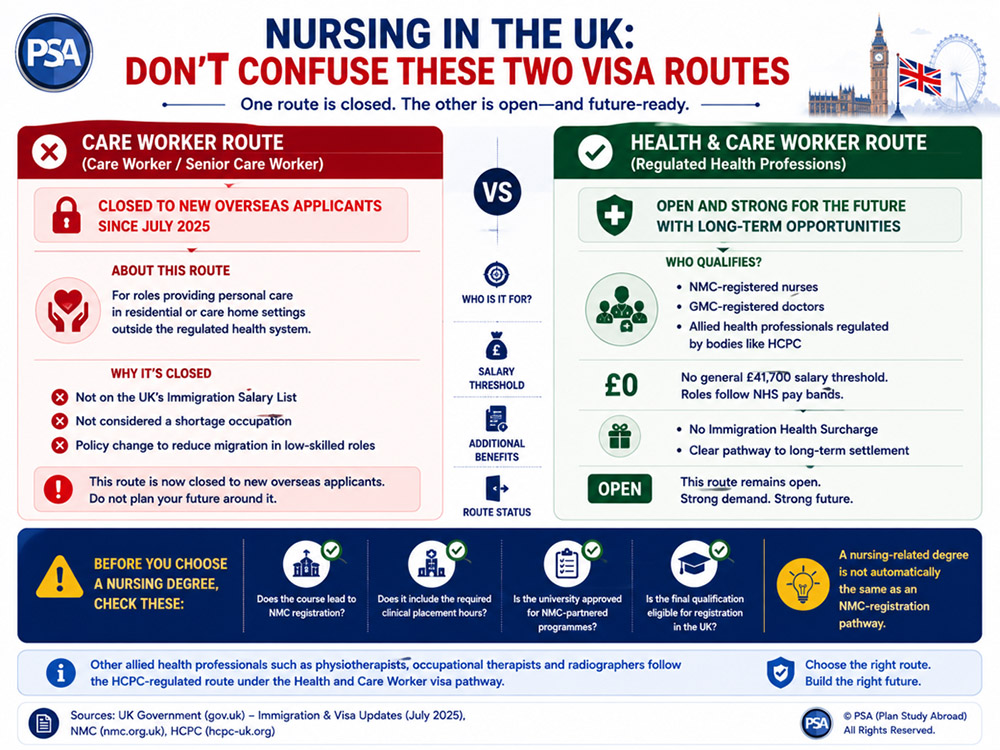
This one needs a careful distinction, because two very different visa routes get confused constantly, and getting this wrong is the single costliest mistake a nursing-track student can make. The route for care workers and senior care workers closed to new overseas applicants in July 2025.
The Health and Care Worker visa — NMC-registered nurses, GMC-registered doctors, other regulated allied health roles — stays fully open. Confirmed on gov.uk directly. Runs on NHS pay bands, not the general £41,700 threshold. A registered nurse role qualifies at graduate level, no matter which NHS trust. And the visa itself costs less than the standard Skilled Worker route. No Immigration Health Surcharge either. Zero.
Nursing on your shortlist? Check one thing first. Does the UK University Degree explicitly lead to NMC registration? Does it include the clinical placement hours NMC requires? That's it. That single detail is the whole difference between a door that opens and one that doesn't. Physiotherapy, occupational therapy, radiography — same open category, once registered with the HCPC.
Best suited for: A student genuinely set on clinical work itself — that's who this suits. Placement hours are brutal. Only makes sense as an actual career choice. Not a shortcut, not a visa strategy dressed up as one.
5. Biomedical & Pharmaceutical Sciences:
This sits inside the Life Sciences growth sector, one of the eight the government is actively courting foreign investment into, backed by the UK's pharmaceutical and biotech manufacturing base. Course content usually runs through molecular biology, pharmacology. Increasingly — regulatory science too, the stuff behind how a drug clears approval.
Entry salaries in pharma R&D and biotech usually sit below the general Skilled Worker threshold. That's exactly why most graduates need a couple of years under their belt first. Or registration with a relevant professional body. Then sponsorship stops being a stretch and starts being straightforward.
Graduates end up in research, quality assurance, clinical trials, regulatory affairs — pick a lane. Hiring here doesn't move fast, and there's a reason for that. Drugs take years to develop. Companies staff at the same unhurried pace.
This is a slower-burn choice than computing, better suited to a student genuinely drawn to the science rather than chasing the fastest visa math. Progression here is a marathon, and it rewards patience more than speed.
Best suited for: a student prepared to play a longer game academically and financially, with genuine curiosity about the science itself rather than urgency about the visa clock.
6. Renewable Energy & Clean Energy Engineering:
Wind, nuclear, hydrogen, carbon capture — all four sit inside Clean Energy Industries. Fastest-growing line in the whole Industrial Strategy right now, backed by billions already committed to infrastructure. Degrees here mix core mechanical or electrical engineering with specialist modules — energy systems, sustainability.
Graduate engineers are getting absorbed two ways: established utilities on one side, a wave of new offshore wind, nuclear, and hydrogen projects on the other. Entry salaries clear the new-entrant threshold fast enough. And net zero being a government priority means hiring demand holds up over the next decade — more than the usual cyclical sector would.
Here's the trade-off, though. Most of these roles sit outside London. Near ports, often. Coastal wind farms. Nuclear sites up in Scotland, northern England. Factor relocation into the salary math. Regional cost of living too — not just the number on the offer letter.
Best suited for: a student open to living and working outside London, with a real interest in infrastructure and engineering rather than just the appeal of a "green" job title.
7. Mechanical, Aerospace & Advanced Manufacturing Engineering:
Advanced Manufacturing's one of the eight priority sectors. Automotive, aerospace, battery technology, advanced materials — all under one roof. Engineering degrees here usually carry professional accreditation, and that accreditation matters more, long-term, than most students clock going in.
Engineering graduates tend to clear the new-entrant threshold right from day one. Past £41,700 within two, three years — moving from graduate engineer toward chartered status along the way. Suits a particular kind of student. Someone who wants hands-on work. Building physical systems, maintaining them. Not chasing something purely digital.
One thing worth knowing: accreditation from the Institution of Mechanical Engineers, or something similar, matters more here than the university's overall ranking does. Shortens the road to Chartered Engineer status later. That's the whole reason it outweighs prestige.
Best suited for: a student thinking in decades rather than in first-job terms, building steadily toward chartered status rather than expecting it immediately after graduation.
8. Finance, Fintech & Actuarial Science.
Financial services make up roughly 9% of the UK's entire economic output, and the sector is one of the government's eight named priorities, concentrated heavily in London but increasingly spread across Edinburgh, Manchester, and Leeds too. Courses typically blend quantitative finance, risk modelling, and increasingly, the technology layer behind modern fintech products.
Fintech, risk, actuarial science — graduate roles here routinely clear £41,700 straight out of a master's. Study in London especially. Climbs fast from there, too.
Actuarial trainee roles stand out even within that. Strong starting pay. Professional exams the employer usually funds. And once those exams clear — a qualification that's genuinely portable, recognized anywhere in the world. Rare combination, all three landing in one role.
That portability matters more than it sounds. A chartered financial or actuarial qualification earned in London holds its value just as well in Mumbai or Singapore, which isn't true of every degree on this list.
Best suited for: a student comfortable with a heavy exam workload that continues well past graduation — actuarial progression in particular means years of professional exams sat alongside a full-time job.
9. Construction Management & Quantity Surveying.
Less glamorous than AI, and arguably a smarter bet for a student who wants certainty over prestige. The UK's infrastructure and housebuilding pipeline, backed by government-committed investment, needs qualified project managers and quantity surveyors far more urgently than it needs another generalist business graduate.
Salaries in this field clear the sponsorship threshold faster than most people expect, often within the first year of work, because the skill shortage here is genuinely acute rather than merely reported. Courses accredited by the Royal Institution of Chartered Surveyors carry weight, since that accreditation is recognised by employers well beyond the UK.
It rewards a student who's comfortable being the person who gets projects delivered on time and on budget, not just the person who designs them.
Best suited for: A student who values steady work over anything glamorous. Genuinely in-demand, not just trendy. Doesn't mind being on-site either — hands dirty, not stuck behind a desk all day.
10. Business Analytics for Management / Consulting-Track Business Masters:
This sits inside Professional and Business Services, the broadest of the eight sectors, covering everything from management consulting to legal and accounting services. It's the most competitive route on this list, because it draws applicants from every country, not just India, and every Business School in the UK now offers some version of it.
Graduates typically move into strategy, operations, or analytics-adjacent consulting roles, and pay varies sharply by firm size — the largest global firms clear well above £45,000, while boutique consultancies can sit under the general sponsorship threshold, so it's worth checking a specific employer's going rate rather than assuming the new-entrant discount will automatically cover the gap. Choose carefully here — a generic MBA-adjacent degree without a genuine data or analytics core is the one course on this list where the sector-alignment logic can quietly fail you.
The safest version of this degree carries a named specialism, whether that's supply chain, healthcare consulting, or technology strategy, rather than a broad "general management" label that tells an employer very little about what you can do.
Best suited for: a student who can already point to a specific interest or specialism, rather than someone hoping the degree itself will eventually decide that direction for them.
None of these ten courses is wrong. Picking the right one, though — that's personal. Grades, budget, how much risk they can stomach. What they want life to look like, three years out.
That's not something any list, however detailed, can work out on someone's behalf. It's a conversation worth having properly, with an actual transcript and an actual family budget on the table, before two years and a significant chunk of savings go into a single course.
Sector alignment gets you in the room. Salary math gets you the visa. The course you enjoy studying is what gets you through the eighteen months in between.
What the shortened Graduate visa means for your course choice
From 1 January 2027, the Graduate visa drops from two years to eighteen months for anyone completing a Bachelor's or Master's degree in UK, though PhD holders keep their full three years, confirmed by the Home Office.
Six months might sound small. It isn't.
It means the clock on finding a sponsor starts ticking the moment you graduate, not eighteen months later. University Courses in UK in fast-hiring sectors like computing, data, and finance convert to sponsorship faster, often within the first six to nine months, because employer demand and application cycles are already built around graduate intake. Courses in slower-moving fields like biomedical research or renewable energy may take longer to convert, simply because those hiring cycles run on longer project timelines.
None of this means the shorter runway makes a course a bad choice. It means the course and the career plan now need to be picked together, not one after the other.
And if you come back to India, or move on somewhere else, does the degree still hold up?
This is the question we almost never get asked directly, and it's usually the one that matters most.
In twenty years of doing this, here's the honest pattern we keep seeing. The same skill sets that clear a UK Skilled Worker sponsorship bar — AI, data, cybersecurity, engineering, finance — are exactly what multinational companies are now hiring for out of their India-based teams, running the same functions they used to run only out of London or Dublin. UK Universities for master's in one of these fields doesn't expire the moment you land back in Bengaluru or Pune.
The degree that travels best has a genuinely technical or regulated core. Computing, engineering, actuarial science — reads the same to a hiring manager whether the interview's in Canary Wharf or Whitefield. A degree built entirely around one country's regulatory quirks, its specific cultural context? That one travels a lot less well.
This isn't a consolation prize for students who don't get sponsored. It's a second, entirely legitimate outcome that should be part of the plan from day one, not a fallback discussed only after things don't go to plan in the UK.
Where the UK still wins, and where it honestly doesn't
The UK still offers something few competitors can match: UK’s one-year master's programmes at globally recognised universities, at roughly half the time commitment of a typical two-year US degree. That matters enormously when you're financing the degree yourself.
It doesn't offer guaranteed employment, a guaranteed visa outcome, or the two-year cushion the Graduate route used to provide. Anyone telling you otherwise, including any counsellor, isn't being straight with you.
The honest trade-off is this: the Study in UK rewards a student who picks a sector-aligned course and moves fast once they graduate. It's less forgiving than it was three years ago for a student who picks a course on prestige alone and figures out the job search later.
A one-year master's is a sprint now, not a stroll. Pick a course where the sprint has a clear finish line. That finish line is a sponsor, not just a graduation photo.
Conclusion
Ten courses, one underlying test: real, government-backed sector growth, and a starting salary that clears the sponsorship bar within a realistic timeframe. Everything else in this list is useful detail, not the deciding factor.
That's the exact test a Global Reach’s experienced UK counsellor run for every family who sits down with them, one transcript at a time, rather than one list applied to everyone equally.
For years of doing this, the same pattern shows up constantly. The course that looks strongest on a university's own webpage isn't always the one that fits a specific student's grades, budget, and career goal, and a generic ranking rarely catches that mismatch before it's too late to fix.
Global Reach has been doing exactly this kind of matching for Indian students headed to the UK for over 35+ years, and holds AIRC certification precisely because that track record deserves to be checked independently, not just taken on faith.
If you're weighing one of these ten courses, or unsure whether your own shortlist clears the sponsorship math this article just walked through, that's worth a proper conversation before you commit two years and a significant sum of money.
Talk to a Global Reach counsellor with your actual transcript and budget on the table, and get a straight answer on which of these ten, or which alternative entirely, genuinely fits you.
The sector matters. The salary math matters. Getting both right for your specific situation is what gets you across the finish line.
Frequently Asked Questions
What are the most in-demand courses to study in the UK right now for Indian students?
The high-demand courses in the UK for Indian students worth shortlisting right now sit inside the government's eight priority growth sectors: AI, data science, and cybersecurity within Digital and Technologies; nursing and allied health for NMC-registered routes; renewable energy engineering; finance and actuarial science; and construction management. The common thread isn't the subject's popularity, it's whether a realistic starting salary in that field clears the Skilled Worker sponsorship threshold within the visa timeline you have.
Is it still possible to get a job in the UK after graduating in 2027?
Yes. Takes more planning than three years back, though. HESA's Graduate Outcomes data has it at 87% — the 2023/24 UK graduate cohort, in work or further study 15 months out. That shortened 18-month Graduate visa, kicking in January 2027, changes the math. Students need sectors with faster hiring cycles now. Can't assume a long runway to land sponsorship anymore.
Which UK courses are most likely to lead to a sponsored work visa?
Courses feeding into jobs that clear £41,700 — the general Skilled Worker threshold — or £33,400, the new-entrant discount, convert to sponsorship most reliably. Computing, engineering, finance, actuarial roles: usually clear that bar fast, often inside the first year on the job.
Nursing works differently. Separate route entirely, running on NHS pay bands, reserved for NMC-registered graduates. Doesn't touch the general salary threshold everyone else gets measured against.
How does the Graduate Route visa change from January 2027 affect my course choice?
Degrees finishing from 1 January 2027 onward — 18 months of post-study work, not two years. PhD holders sit outside this, keep their three years untouched.
That shift favors fast-hiring sectors. Data, computing, finance — recruitment cycles there line up fine with a shorter runway. Biomedical research doesn't move that fast, though. Needs a sponsorship plan built in from day one, deliberately, not left to sort itself out later.
Is nursing still a good option for Indian students given the care worker visa changes?
Yes - but the distinction matters more than people realize. Care workers, senior care workers: that route closed to new overseas applicants back in July 2025. Done. Separate story for the Health and Care Worker visa, though — NMC-registered nurses, still fully open, still running on NHS pay bands instead of the general threshold.
The whole thing hinges on one choice. Pick a UK nursing degree that actually leads to NMC registration. Not a care-focused qualification that stops short of it.
What salary do I need to earn in the UK to qualify for a Skilled Worker visa after graduating?
The general threshold is £41,700 a year, or the occupation's published going rate, whichever is higher. Recent graduates under 26, recent leavers, or those switching from a student or Graduate visa, often qualify for a new-entrant discount down to £33,400. Health and care roles follow separate NHS pay bands rather than either of these general thresholds, so nurses and doctors should check the NHS band for their specific role instead.
Are UK degrees still worth the cost given the current job market?
For a course aligned with a growing sector and a realistic sponsorship-clearing salary, yes, particularly given the UK's one-year master's format compared to two years elsewhere. For a course chosen on prestige alone without a plan for what comes after graduation, the calculation is far shakier than it was three years ago. The course choice, not the country choice, is what's changed.
Which UK sectors are actually growing and hiring right now?
The UK's Modern Industrial Strategy names eight priority sectors for the next decade. Advanced Manufacturing, Clean Energy Industries, Creative Industries, Defence, Digital and Technologies, Financial Services, Life Sciences, Professional and Business Services. These aren't marketing labels dreamed up for a brochure. This is where government money and hiring demand both sit right now — which makes it the steadiest anchor for a course choice, this year especially.